
 = Partner Site
Harriet the Spy Reading Level: A Complete Guide
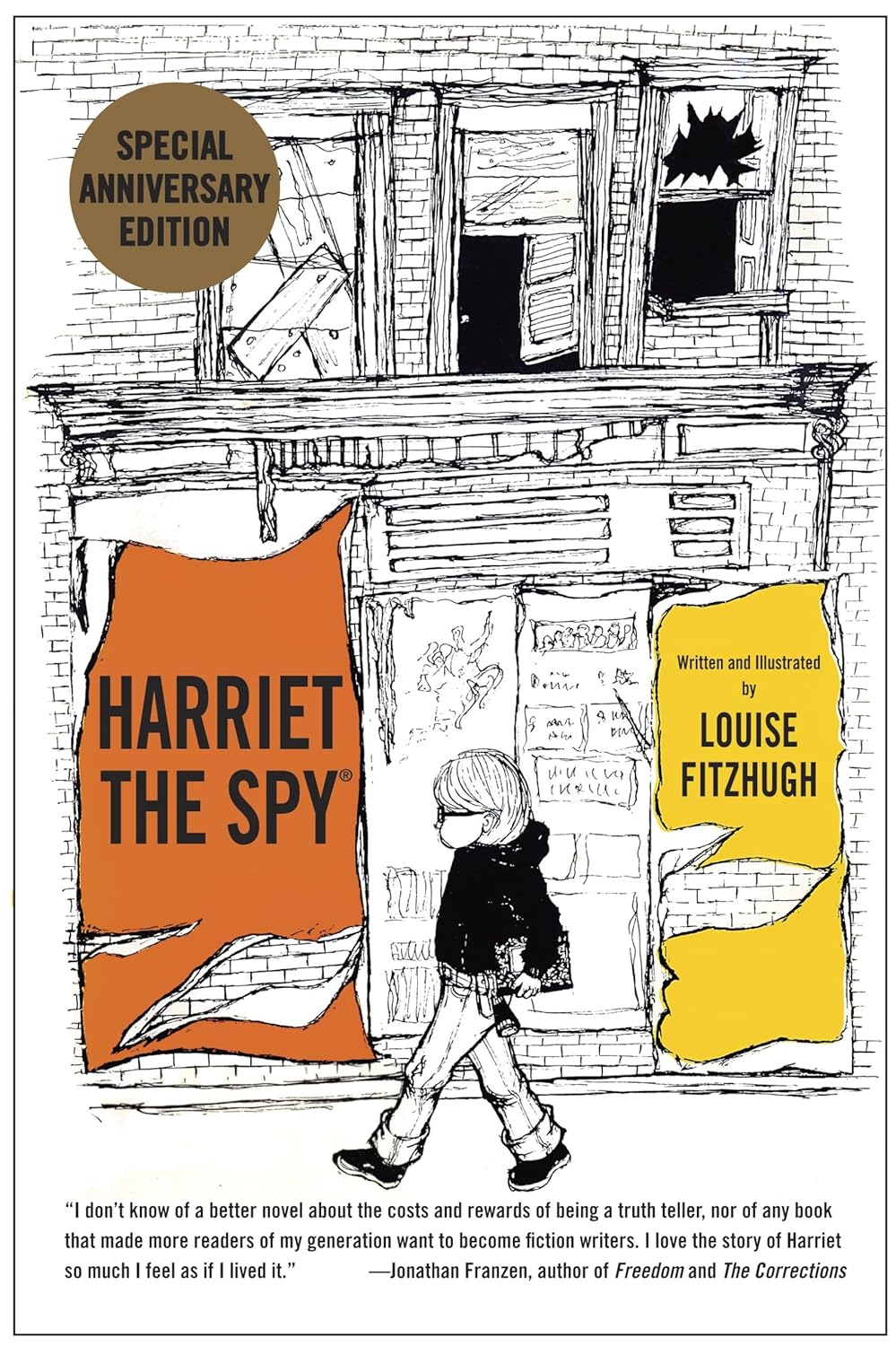
Harriet the Spy by Louise Fitzhugh is a groundbreaking and frequently subversive novel about an eleven-year-old girl in New York City who keeps a notebook in which she records her ruthlessly honest observations about everyone she knows — and who is destroyed, and rebuilt, when her notebook is found and read. One of the most original children’s novels ever published in America, it created a new kind of protagonist: a girl who is difficult, perceptive, sometimes unkind, and completely real. Published in 1964, it remains as sharp and strange and necessary as the day it appeared. This complete guide covers the reading level, age appropriateness, themes, characters, and everything parents and teachers need to know about this important and enduring book.
For Parents
Harriet the Spy is a novel about a girl who writes down exactly what she thinks about everyone, whose notebook is found, and who must deal with the consequences of her own honesty — while also dealing with the loss of her beloved nanny, Ole Golly, whose departure sets the whole story in motion. Best suited for readers ages 9-12, it is one of those rare books that takes the inner life of a child completely seriously: Harriet’s observations are often funny, frequently unfair, and entirely recognizable as the thoughts of a child who is still learning the difference between private truth and public cruelty. Parents should know it involves social ostracism, some mean behavior between children, and a protagonist who is not always sympathetic. This is a feature, not a flaw.
For Teachers
A widely taught classic well suited to grades 4-6, Harriet the Spy is an exceptional text for teaching character development, point of view, and the ethics of writing about real people. Harriet’s notebook — her habit of recording honest observations without consideration for their impact — opens essential discussions about the difference between private writing and public speech, between observation and judgment, between the writer’s freedom and the reader’s dignity. The novel is also a superb model for teaching close, specific observation as a writing skill. It pairs naturally with writing workshops focused on personal notebooks and with units on the ethics of storytelling.
Harriet the Spy at a Glance
Find on Amazon →| Author | Louise Fitzhugh |
| Published | 1964 |
| Grade Level | 4-6 (our assessment) |
| Recommended Age | 9-12 |
| Flesch-Kincaid Grade | 4.9 |
| Word Count | ~67,000 |
| Pages | 298 (standard paperback) |
| Chapters | 17 |
| Genre | Realistic fiction / classic children’s literature |
| Setting | New York City (Upper East Side), 1960s |
| Awards | ALA Notable Book; New York Times Best Illustrated Children’s Book (1964) |
For official Lexile and AR levels, visit Lexile.com or AR BookFinder. ReadingVine provides independent editorial assessments.
What Reading Level Is Harriet the Spy?
Harriet the Spy reads at approximately a 4th-6th grade level by our editorial assessment, with a Flesch-Kincaid grade level of around 4.9. Fitzhugh writes in a style that feels immediate and intimate — Harriet’s voice is distinct and propulsive, and her notebook entries, scattered throughout the text, have a clipped specificity that is unlike anything else in children’s literature of the era. The prose moves quickly and the social dynamics of Harriet’s world are vivid and recognizable.
At nearly 300 pages and roughly 67,000 words, the book is substantially longer than most novels associated with grades 3-5, and readers who are not immediately engaged by Harriet’s voice may find the middle sections slow. But readers who click with the novel — and many do, intensely — find it nearly impossible to put down. The social world of Harriet’s school and neighborhood is rendered with a specificity and psychological accuracy that rewards close reading and that many children recognize, with some shock of recognition, as more honest than most books they have encountered.
The book is most commonly recommended for grades 4-6. For official Lexile and Accelerated Reader scores, visit Lexile.com or AR BookFinder.
What Age Is Harriet the Spy Appropriate For?
We recommend Harriet the Spy for readers ages 9-12. The novel deals with social ostracism, the cruelty children show one another, grief at the loss of an important adult relationship, and a protagonist whose behavior is sometimes genuinely unkind. None of this is graphic or frightening, but it is emotionally honest in ways that younger readers may find difficult.
When Harriet’s notebook is found and read by her classmates, the social fallout is sustained and ugly: she is excluded, mocked, and targeted with deliberate cruelty by children who were her friends. This is depicted with full emotional honesty rather than softened or quickly resolved. Ole Golly’s departure — Harriet’s beloved nanny and primary emotional anchor — is a genuine loss that affects Harriet deeply throughout the novel. Harriet’s notebook entries themselves are often unkind: she writes unflattering observations about her neighbors, classmates, and even her parents, which some parents find concerning as a model. The novel’s position on this is nuanced: it does not endorse Harriet’s carelessness with others’ feelings, but it does endorse her honesty and her right to her private observations. A brief period of disordered behavior following Ole Golly’s departure — Harriet stops eating, becomes erratic — is depicted and addressed. There is no sexual content and no strong language.
For children who have experienced social exclusion or who are navigating complex friend group dynamics, the novel can be deeply validating — it is one of the most honest depictions of middle-childhood social life in all of children’s literature. Parents who are concerned about the unkind notebook entries should know that the novel treats their consequences seriously and that Harriet’s eventual reconciliation with her classmates requires genuine growth on her part.
What Is Harriet the Spy About?
Harriet M. Welsch is eleven years old, lives in a townhouse on the Upper East Side of Manhattan, and wants to be a writer. Her nanny, Ole Golly, has told her that a writer must know everything, and Harriet has taken this instruction literally: she keeps a notebook in which she writes down everything she observes, about everyone she knows, with complete honesty and no consideration for what would happen if anyone read it. Her neighbors on her spy route — a reclusive man named Harrison Withers who keeps twenty-six cats, a woman named Mrs. Plumber who lies in bed all day planning her next acquisition, a family called the Dei Santis who run a grocery — are all subjected to Harriet’s unsentimental scrutiny. So are her classmates. So are her parents.
Then Ole Golly leaves to get married, and something in Harriet’s careful, ordered world comes loose. Ole Golly has been not just a nanny but the person who has understood Harriet most completely — who has taken her intelligence seriously, encouraged her writing, and provided the steady emotional anchor against which Harriet’s intensity could rest. Without Ole Golly, Harriet begins to fray.
And then her classmates find the notebook. They read what Harriet has written about them: that Sport smells, that Janie is going to be a scientist and blow up the world, that Marion Hawthorne is a hypocrite. The social consequences are swift and total. Harriet is excluded from the group she belonged to, targeted with escalating cruelty, and left to navigate the wreckage of her social life entirely alone. Her parents, alarmed, take her to a psychiatrist. Ole Golly, from a distance, sends a letter.
The letter from Ole Golly is the novel’s pivot. Ole Golly tells Harriet two things: that she must apologize, and that if she cannot bring herself to mean the apology, she must lie. This is one of the most unusual pieces of advice in children’s literature — a direct instruction to a child that sometimes you must say what you don’t feel for the sake of the people you have hurt — and it is delivered without softening. Harriet becomes editor of the class newspaper, uses it to say kind things about the people she hurt, and slowly, imperfectly, begins to rebuild.
Louise Fitzhugh drew on her own experience of New York City, her own outsider sensibility, and her conviction that children’s literature was not doing justice to the complexity of children’s actual inner lives. She wanted to write a child who was not nice, who was perceptive and difficult and honest in ways that caused harm, and who had to reckon with that harm without the novel pretending it didn’t happen. She succeeded completely.
Harriet the Spy Characters
Is Harriet the Spy Banned?
Harriet the Spy has a significant history of challenges and appears on American Library Association lists of frequently challenged and banned books. Challenges have been based on Harriet’s dishonesty (she lies, including at Ole Golly’s instruction), her unkind notebook entries, her general failure to be a positive role model, and occasionally her relationship with Ole Golly, which some challenges have described as inappropriate. The educational community has consistently and strongly defended the novel, and it has remained in print and in classrooms for sixty years. The ALA has cited it as a landmark of realistic fiction for children precisely because it refuses to make its protagonist nicer than children actually are. The very qualities that have generated challenges — Harriet’s honesty, her difficulty, her unfiltered inner life — are the qualities that have made it essential reading for sixty years of children who recognized themselves in her.
Harriet the Spy Themes and Lessons
The central theme of Harriet the Spy is the ethics of observation — specifically, the question of what a writer owes to the people she writes about. Harriet believes, with the completeness of an eleven-year-old, that her notebook is purely private: that what she writes there is hers, honest and free, and carries no obligation to the people it describes. The catastrophe of the notebook’s discovery confronts her with the fact that writing about real people is never entirely private, that honesty without kindness is a form of cruelty, and that the writer’s freedom and the reader’s dignity are in permanent tension. This is a genuinely important ethical insight, and Fitzhugh delivers it through plot rather than preachment — Harriet learns it from what happens to her, not from being told.
Ole Golly’s departure is the novel’s emotional engine and its second great theme: the loss of the adult who has made you who you are, and the question of who you are when that person is gone. Harriet’s crisis after Ole Golly leaves is not simply sadness but disorientation — she has built herself around Ole Golly’s understanding of her, and without it she does not know what she is. Her reconstruction, over the novel’s second half, is the story of a child learning to hold herself together with her own hands.
The novel is also, more quietly, about the specific loneliness of being a perceptive child — one who sees more than is comfortable, who thinks more than she can easily share, and who does not fit the social templates available to her. Harriet is not cruel by nature; she is honest by nature in a world that requires performance. The gap between those two things is where the novel lives.
Discussion starters for classrooms and families: Is it wrong for Harriet to write honestly in her private notebook? Does it become wrong when others read it? What does Ole Golly mean when she tells Harriet to apologize even if she doesn’t mean it — is that good advice? How does Harriet change over the course of the novel? What makes Sport and Janie good friends even when Harriet is not? What does the novel suggest a writer owes to the people she writes about?
How Many Pages and Chapters Are in Harriet the Spy?
The standard paperback edition of Harriet the Spy is 298 pages, divided into 17 chapters averaging around seventeen pages each. The word count is approximately 67,000 words — on the longer end for a novel most associated with grades 4-6, and noticeably longer than most comparable classics of its era. The chapters are substantial, and the novel rewards readers who are ready for a longer, more immersive reading experience.
For readers in the target age range of 9-12, expect a reading time of roughly 6-9 hours, or about two weeks of comfortable reading at 30 minutes per session. As a classroom text, it works well in a three-week unit, with the notebook entries providing particularly rich material for writing exercises. The novel’s structure — a stable first half, a catastrophic middle, and a rebuilding final section — maps naturally onto narrative arc discussions. Individual chapters, particularly those featuring Harriet’s spy route observations or her notebook entries, work as standalone reading and writing models.
Books Similar to Harriet the Spy
About Louise Fitzhugh
Louise Fitzhugh (1928-1974) was born in Memphis, Tennessee, raised by her father and stepmother after her parents divorced, and spent her adult life in New York City, where she became part of the literary and artistic community of the 1950s and 1960s. She was a painter as well as a writer, and the illustrations throughout Harriet the Spy — spiky, expressive, and perfectly matched to Harriet’s angular sensibility — are her own. Harriet the Spy, published in 1964, was her first novel and remains her most celebrated. She followed it with The Long Secret (1965), a sequel following Harriet and her friends the following summer, and Nobody’s Family Is Going to Change (1974), a novel about a Black middle-class family in New York whose children’s ambitions conflict with their parents’ expectations. She died in 1974 at the age of forty-six, leaving an unfinished manuscript that was later published as Sport. Fitzhugh’s willingness to write a child protagonist who was difficult, perceptive, and not conventionally likable changed what American children’s literature thought it was allowed to do, and the books that followed in her wake — realistic, psychologically honest, willing to let children be complicated — owe her a considerable debt.
Harriet the Spy: Frequently Asked Questions
What reading level is Harriet the Spy?
Harriet the Spy has a Flesch-Kincaid grade level of approximately 4.9. Our editorial assessment places it at grades 4-6 (ages 9-12). At nearly 300 pages, it is longer than most novels associated with this age group, and the social dynamics it depicts reward readers who are emotionally ready for its complexity. For official Lexile and AR scores, visit Lexile.com or AR BookFinder.
Is Harriet the Spy a good role model?
This is the question the novel has always generated, and the honest answer is: not exactly, and that is the point. Harriet is honest, observant, determined, and genuinely curious about the world — these are admirable qualities. She is also careless with other people’s feelings, unwilling to consider the consequences of her honesty for the people she is honest about, and slow to apologize. The novel does not ask readers to imitate Harriet; it asks them to understand her, which is a different and more demanding thing. The question of what she gets right and what she gets wrong — and what the difference costs her — is precisely what makes the book worth reading and worth discussing.
What does Ole Golly mean when she tells Harriet to lie?
After Harriet’s notebook is found and her social world collapses, Ole Golly writes her a letter with two pieces of advice: apologize, and if you cannot bring yourself to mean the apology, say it anyway. This instruction — to perform contrition even without feeling it — is one of the most unusual and most discussed passages in the novel. Ole Golly is not telling Harriet that lying is good; she is telling her that social life requires the performance of repair even when the inner truth is not yet there, and that sometimes doing the right action comes before feeling the right feeling. It is a pragmatic, adult piece of wisdom, and the novel gives it to Harriet without softening it into something more comfortable. Teachers and parents who discuss this passage with children often find it generates the richest conversations in the book.
What is Harriet’s spy route?
Every day after school, Harriet follows a fixed route through her Upper East Side neighborhood, stopping at the homes and businesses of the people she observes, watching them through windows and from hiding places, and recording everything she sees in her notebook. Her spy route includes Harrison Withers (a man who lives alone with twenty-six cats and makes birdcages), the Dei Santis family (who run a grocery and seem always to be arguing), the Robinsons (a wealthy family), and others. The spy route is Harriet’s education in the world — her method of learning what people are actually like beneath their social surfaces — and the specific observations she records there are some of the novel’s funniest and most incisive writing.
What grade is Harriet the Spy typically assigned in?
Harriet the Spy is most commonly assigned in grades 4, 5, and 6, both as independent reading and as a class text. It is particularly well suited to units on realistic fiction, personal narrative writing, and the ethics of observation and storytelling. Many teachers use Harriet’s notebook entries as a model for teaching close, specific observation as a writing skill. The novel’s social dynamics also make it a natural text for discussions about friendship, honesty, and the difference between private and public speech.
Is there a sequel to Harriet the Spy?
Yes — The Long Secret (1965), Fitzhugh’s follow-up novel, takes place the summer after Harriet the Spy and follows Harriet and Beth Ellen Hansen (a minor character from the first book) in the Hamptons. It is not as celebrated as the original but shares its honesty and its willingness to take children’s inner lives seriously. A much later sequel, Harriet Spies Again (2002), was written by Helen Ericson after Fitzhugh’s death and authorized by her estate; it features Harriet in a new adventure but is not considered part of Fitzhugh’s own work.
Why was Harriet the Spy controversial when it was published?
When Harriet the Spy was published in 1964, it broke several unwritten rules of American children’s literature. Harriet lies. She is unkind. She does not learn her lesson cleanly or completely. Her parents are somewhat inadequate. Her nanny tells her to apologize insincerely. The book does not end with everything resolved and everyone happy. Children’s literature in 1964 was expected to feature protagonists who were fundamentally good, whose flaws were correctable, and whose stories ended with clear moral lessons. Harriet violated all of these expectations, and some librarians and parents objected strongly. The children, however, loved her — recognized her — immediately. The controversy has faded; the book has not.