
 = Partner Site
The View from Saturday Reading Level: A Complete Guide
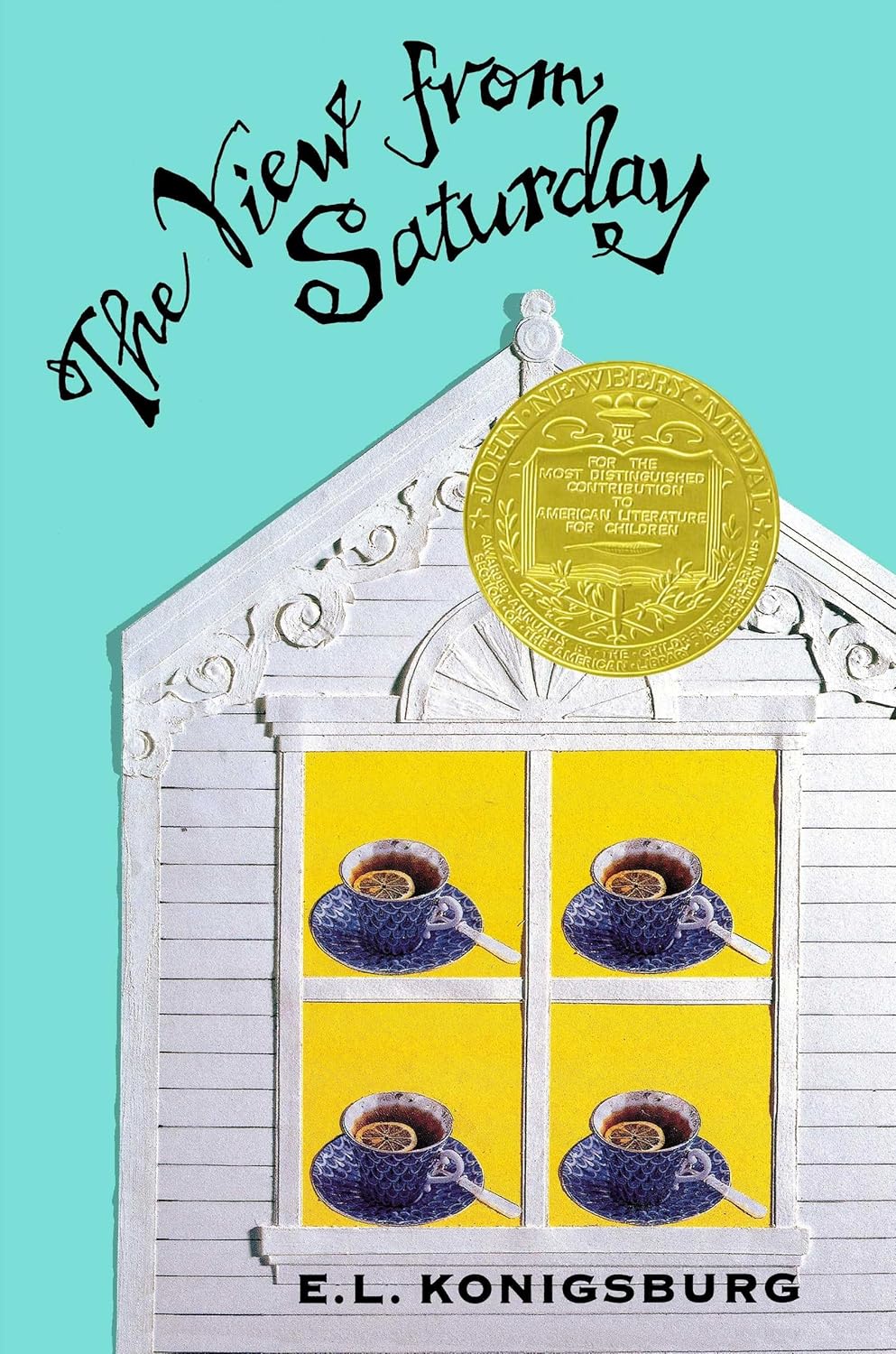
The View from Saturday by E.L. Konigsburg is a Newbery Medal-winning novel about four sixth graders — Noah, Nadia, Ethan, and Julian — who are chosen by their paraplegic teacher, Mrs. Olinski, to form the school’s Academic Bowl team, and who proceed to defeat every other team in the state. Told in interlocking chapters that spiral backward and forward through time, it is a novel about connection, elegance, and the particular grace of people who find each other at exactly the right moment. Witty, formally ambitious, and emotionally precise, it is one of the most unusual Newbery Medal winners in the award’s history — a puzzle-box of a novel that rewards rereading as much as the first encounter. This complete guide covers the reading level, age appropriateness, themes, characters, and everything parents and teachers need to know about this remarkable book.
For Parents
The View from Saturday is a quiet, intelligent, deeply pleasurable novel about four unusually good children and the teacher who recognizes them. Best suited for readers ages 9-12, it has essentially no content concerns and every content virtue: it is funny, warm, formally inventive, and full of the specific pleasure of watching people who are very good at something do it very well. It is also, beneath its Academic Bowl framework, a novel about kindness as a practice and about how genuinely good people find each other. Parents who loved Konigsburg’s From the Mixed-Up Files of Mrs. Basil E. Frankweiler will find this a richer and more complex achievement.
For Teachers
A Newbery Medal book well suited to grades 4-6, The View from Saturday is an exceptional text for teaching nonlinear narrative structure, multiple-perspective storytelling, and how authors use form to reinforce theme. The novel’s interlocking structure — each character’s backstory illuminating the others’ — is itself a portrait of the interconnection it is describing, and examining how Konigsburg constructs that structure is one of the richest craft discussions available at this grade level. The novel also opens substantive discussions about disability, community, what it means to be genuinely kind rather than merely polite, and how the right teacher changes students’ lives.
The View from Saturday at a Glance
Find on Amazon →| Author | E.L. Konigsburg |
| Published | 1996 |
| Grade Level | 4-6 (our assessment) |
| Recommended Age | 9-12 |
| Flesch-Kincaid Grade | 5.9 |
| Word Count | ~42,000 |
| Pages | 163 (standard hardcover) |
| Chapters | 6 (plus framing chapters) |
| Genre | Realistic fiction / literary fiction |
| Setting | Epiphany, New York (a fictional small town), 1990s |
| Awards | Newbery Medal (1997) |
For official Lexile and AR levels, visit Lexile.com or AR BookFinder. ReadingVine provides independent editorial assessments.
What Reading Level Is The View from Saturday?
The View from Saturday reads at approximately a 4th-6th grade level by our editorial assessment, with a Flesch-Kincaid grade level of around 5.9. Konigsburg writes with the dry, precise wit and the slightly elevated vocabulary that characterize all her best work — sentences that are exactly as long as they need to be, never a word wasted, with the occasional perfectly placed observation that rewards readers who are paying full attention. The novel’s humor is primarily verbal rather than physical, and readers who respond to wit and irony will find it on nearly every page.
What makes the novel more demanding than its word-level score suggests is its structure. The View from Saturday is not told chronologically or from a single perspective: it opens at the Academic Bowl competition, moves into Mrs. Olinski’s retrospective narration, and then spirals into each of the four students’ backstories in turn, with each backstory connecting to and illuminating the others. Readers who prefer a straightforward linear narrative may find the structure initially disorienting. Readers who enjoy the pleasure of a puzzle assembling itself — who enjoy noticing how each piece connects to the others — will find the structure one of the novel’s greatest pleasures.
At just 163 pages, it is one of the shorter Newbery Medal winners, but it rewards slow reading and rereading. The novel is most commonly recommended for grades 4-6. For official Lexile and Accelerated Reader scores, visit Lexile.com or AR BookFinder.
What Age Is The View from Saturday Appropriate For?
We recommend The View from Saturday for readers ages 9-12. This is one of the most content-concern-free novels in the Newbery canon — gentle, warm, and entirely without anything that requires parental guidance beyond the novel’s emotional and structural demands.
There is essentially nothing in The View from Saturday that requires a content warning. Mrs. Olinski uses a wheelchair following an automobile accident, and the novel addresses her disability and the adjustments it requires with matter-of-fact honesty. Several characters navigate family changes — a divorce, a remarriage, a blended family — depicted without drama or distress. A subplot involves the rescue of sea turtle eggs, which requires some mild nighttime adventure. None of this requires advance parental guidance. This is one of those novels parents can hand to children of almost any age within the recommended range with complete confidence.
The View from Saturday is one of those novels that grows with its reader — children who encounter it at nine will love it for the Academic Bowl competition and the four friends; those who return to it at twelve will notice the structural elegance and the deeper portrait of what it means to be genuinely good. It is worth recommending twice, at different ages.
What Is The View from Saturday About?
Mrs. Eva Marie Olinski is a sixth-grade teacher at Epiphany Middle School in a small New York town. She uses a wheelchair. She is returning to teaching after a long absence following an accident that changed her life. When she is asked to choose four students to form the school’s Academic Bowl team, she chooses Noah Gershom, Nadia Diamondstein, Ethan Potter, and Julian Singh — a choice that surprises the school administration and that Mrs. Olinski herself cannot fully explain, except to say that she knew.
The four students call themselves The Souls. They have been meeting on Saturday afternoons for tea — a ritual Julian initiated, in the formal, particular way Julian does everything — and in those Saturday meetings something has formed between them that is hard to name exactly but that functions as grace. They are not a natural friend group. They have different backgrounds, different temperaments, and different histories. What they share is a quality of attention — to each other, to the world, to the specific texture of things — that distinguishes them from everyone around them and that makes them, as a team, unexpectedly formidable.
The novel’s Academic Bowl chapters frame a set of backstory narratives that spiral outward from the present: Noah’s story, which involves a bar mitzvah project, a calligraphy pen, and a wedding on a Florida riverboat; Nadia’s story, which involves sea turtle nesting season, her divorced parents, and a stepgrandfather named Izzy; Ethan’s story, which involves a bully, a rescued dog, and a cast for a school play; Julian’s story, which involves his move from India, his grandfather’s dignity, and the particular grace he carries with him everywhere. Each story intersects with the others in ways that become clear gradually, and the connections between them are one of the novel’s deepest pleasures.
E.L. Konigsburg was already a celebrated author when she wrote The View from Saturday — she had won the Newbery Medal in 1968 for From the Mixed-Up Files of Mrs. Basil E. Frankweiler, making her the only author to have both the Medal and an Honor in the same year when she also received an Honor for Jennifer, Hecate, Macbeth, William McKinley, and Me, Elizabeth. The View from Saturday won the Newbery Medal in 1997, making Konigsburg one of the very few authors to have won the Medal twice. She was sixty-one years old when she wrote it and considered it her finest work.
The View from Saturday Characters
Is The View from Saturday Banned?
The View from Saturday has not been banned or challenged and does not appear on lists of frequently challenged books. It is one of the most universally embraced Newbery Medal winners — shelved in virtually every school and public library, recommended without reservation by librarians and teachers, and entirely without the content elements that typically generate challenges. Its formal ambition and its quietly serious treatment of kindness and connection have been cited as strengths rather than concerns.
The View from Saturday Themes and Lessons
The central theme of The View from Saturday is kindness as something practiced rather than felt — the argument that being genuinely good is not a quality you have but a set of choices you make, moment by moment, about how to pay attention to the people around you. The four students who form The Souls are not paragons; they are children who have each, in their own backstory, made a choice to notice something that could have been ignored, to help someone who did not ask for help, to be present in a situation in a way that cost them something. These are small choices. The novel’s argument is that small choices made consistently are how character is built.
The novel’s formal structure — the interlocking backstories, the way each character’s history illuminates the others’ — is itself a portrait of this theme. The connections between the four students’ stories are not coincidences but consequences: each act of genuine attention has ripple effects that touch the others. The form enacts the argument. Konigsburg is showing, not telling, that the world is made of connections that only become visible when you are paying the right kind of attention.
Mrs. Olinski’s disability and her return to teaching are the novel’s third great theme — a portrait of what it means to rebuild a life and a self after a catastrophic disruption, and of the specific gift that students can give a teacher who is finding her way back. The Souls chose Mrs. Olinski, in a sense, as much as she chose them, and the novel’s gradual revelation of this mutual choosing is one of its most moving structural achievements.
Discussion starters for classrooms: Why does Mrs. Olinski choose these four students? What do the four students have in common that the novel never states directly? How does each character’s backstory connect to the others’? What does it mean to be genuinely kind rather than merely polite? How does the Saturday tea ritual function in the novel — what does it give the four students that they don’t get elsewhere? What does the title mean?
How Many Pages and Chapters Are in The View from Saturday?
The standard hardcover edition of The View from Saturday is 163 pages — making it one of the shorter Newbery Medal winners and one of the most deceptively brief novels in the canon. Its chapter structure is unusual: the book is divided into six primary chapters, each focused on a different character or competition round, plus framing sections that establish Mrs. Olinski’s perspective. The word count is approximately 42,000 words. The brevity is not thinness; the novel is compressed in the way a very good short story is compressed, with every sentence doing more than one kind of work.
For readers in the target age range of 9-12, expect a reading time of roughly 3-4 hours, or about a week of comfortable reading at 20-30 minutes per session. Many readers finish it in a single sitting on a Saturday afternoon, which feels appropriate. As a classroom text, the novel works well in a two-week unit, with the structural complexity rewarding the kind of close discussion that can unpack how the interlocking backstories connect. Rereading individual chapters after finishing the whole novel is a particularly rewarding activity — the connections that were invisible on first reading become clear on second.
Books Similar to The View from Saturday
About E.L. Konigsburg
E.L. Konigsburg (1930-2013) is one of the most celebrated American children’s authors of the 20th century and the only author in Newbery history to have won the Medal and an Honor in the same year — in 1968, when From the Mixed-Up Files of Mrs. Basil E. Frankweiler won the Medal and Jennifer, Hecate, Macbeth, William McKinley, and Me, Elizabeth received an Honor. The View from Saturday, published in 1996 when Konigsburg was sixty-one, won the Newbery Medal in 1997, making her one of the very few authors to have won the Medal twice. She considered it her finest work. Born in New York City and raised in small Pennsylvania towns, she earned a degree in chemistry before turning to writing and illustration, and her scientific training is visible in the precision and economy of her prose. Her other notable novels include The Second Mrs. Giaconda, A Proud Taste for Scarlet and Miniver, and The Outcasts of 19 Schuyler Place. She lived and worked in Florida until her death in 2013 at the age of eighty-two.
The View from Saturday: Frequently Asked Questions
What reading level is The View from Saturday?
The View from Saturday has a Flesch-Kincaid grade level of approximately 5.9. Our editorial assessment places it at grades 4-6 (ages 9-12). The prose is precise and witty, and the nonlinear structure requires readers comfortable with assembling a narrative from multiple perspectives. At just 163 pages it reads quickly but rewards slow attention and rereading. For official Lexile and AR scores, visit Lexile.com or AR BookFinder.
Why are the four students called The Souls?
The name is Julian’s, given with the same quiet certainty with which he does everything. The novel does not offer an elaborate explanation for the name, and this is characteristic of Konigsburg’s method: she trusts readers to feel what the name means rather than explaining it. The Souls are children who are paying attention in a way that most children — most people — are not. They are present to each other and to the world with a completeness that is rare enough to deserve a name. Julian recognizes this quality in each of them before they fully recognize it in themselves, which is part of what makes him the center around whom the group forms.
How does the novel’s nonlinear structure work?
The novel opens at the Academic Bowl state championship, where Mrs. Olinski is narrating in retrospect. It then moves into each of the four students’ backstories in turn — Noah’s, Nadia’s, Ethan’s, Julian’s — each told in third-person and set in the months before the Academic Bowl competition begins. The backstories connect to each other: events from Noah’s story reappear in Nadia’s, characters from Nadia’s story appear in Ethan’s, and so on. The connections are not immediately obvious on first reading but become clear as the novel progresses, and become clearer still on a second reading. Konigsburg is using the structure to argue that the connections between people are always there; it depends on how carefully you are looking whether you can see them.
What is the Academic Bowl, and how important is it to the novel?
The Academic Bowl is a middle school academic competition — a team quiz format in which students answer questions across multiple subject areas. It provides the novel’s competitive framework and its forward momentum, but it is not the novel’s real subject. The Academic Bowl is the occasion that brings The Souls together in public and makes their qualities visible to the school and the state. What the novel is actually about — the Saturday teas, the backstory connections, the question of what Mrs. Olinski knew and how she knew it — happens around and beneath the competition rather than in it. The Bowl is the plot; the connections are the story.
What does the title mean?
The title operates on several levels. The most immediate is the view from the Academic Bowl competition — the Saturday competitions that structure the novel’s present-tense frame. But Saturday is also the day of the weekly teas, the day The Souls spend together, and the view from Saturday is the view from that particular vantage point: the perspective available to people who have chosen to be genuinely present to each other on a regular basis. The title suggests that there is a quality of vision available from that position — from the practice of deliberate, weekly, chosen attention — that is not available from any other. What you can see from Saturday is what you cannot see from the rush of ordinary days.
Is The View from Saturday connected to From the Mixed-Up Files of Mrs. Basil E. Frankweiler?
They are not sequels or companion novels — the characters and settings are entirely different. What they share is their author’s sensibility: the dry wit, the precisely observed detail, the portrait of unusually capable children who are operating slightly outside the normal social range, and the New York setting (though Epiphany is a fictional small town rather than Manhattan). Readers who love one will almost certainly love the other, and teachers often assign them together as a unit on Konigsburg’s work. The two Newbery Medals — 1968 and 1997, nearly thirty years apart — reflect a remarkable consistency of quality across an entire career.
What grade is The View from Saturday typically assigned in?
The View from Saturday is most commonly assigned in grades 4, 5, and 6, both as independent reading and as a class text. It is particularly well suited to units on nonlinear narrative structure, multiple perspective, and literary craft. Its brevity makes it practical to teach in its entirety with time for close reading and structural analysis. Many teachers assign it in pairs with From the Mixed-Up Files of Mrs. Basil E. Frankweiler for a unit on Konigsburg, or with The Westing Game for a unit on structurally complex middle grade fiction.