
 = Partner Site
Harry Potter and the Order of the Phoenix Reading Level: A Complete Guide
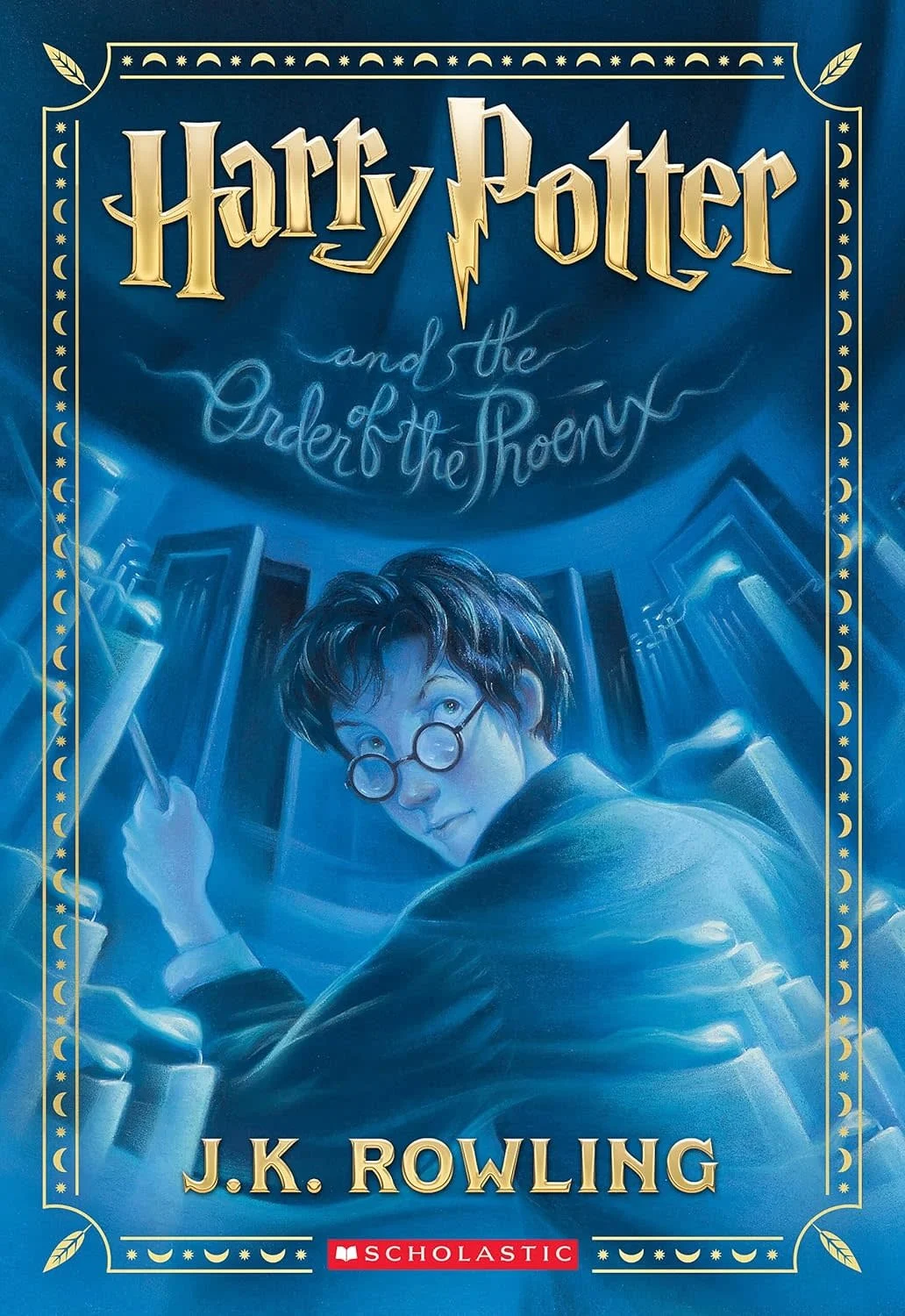
Harry Potter and the Order of the Phoenix by J.K. Rowling is the fifth book in the Harry Potter series, following Harry’s fifth year at Hogwarts as he returns traumatized from the graveyard, disbelieved by nearly everyone, and facing his most insidious antagonist yet — not Voldemort, but the Ministry of Magic’s own Dolores Umbridge. At 870 pages it is the longest book in the series, the angriest, and the one that most explicitly turns the story into a political argument about institutional corruption and the silencing of truth. This complete guide covers Order of the Phoenix‘s reading level, recommended age, content considerations, characters, themes, and books similar to Harry Potter and the Order of the Phoenix, designed for parents, teachers, and students.
For Parents
The longest, darkest, and most emotionally demanding book in the series to this point. Harry is angry, traumatized, and often difficult to be around, which is entirely the point — but parents should be prepared for a book that is more of a slog than its predecessors before it pays off. Best for readers ages 11 and up.
For Teachers
A rich grades 7–9 text for teaching propaganda, institutional corruption, and how systems silence inconvenient truths. Umbridge as a villain type — the bureaucratic enforcer of comfortable lies — is one of the series’ most teachable creations. The book’s length makes it better suited to independent reading with structured discussion than whole-class reading.
Harry Potter and the Order of the Phoenix at a Glance
Find on Amazon →| Author | J.K. Rowling |
| Published | 2003 |
| Grade Level | 7–9 (our assessment) |
| Recommended Age | 11–15 |
| Flesch-Kincaid Grade | ~7.0 |
| Word Count | ~257,000 |
| Pages | 870 (Scholastic paperback) |
| Chapters | 38 |
| Genre | Fantasy / young adult |
| Setting | Hogwarts; Grimmauld Place; the Ministry of Magic; 1995–96 |
| Series | Harry Potter, Book 5 |
For official Lexile and AR levels, visit Lexile.com or AR BookFinder. ReadingVine provides independent editorial assessments.
What Reading Level Is Harry Potter and the Order of the Phoenix?
Order of the Phoenix reads at approximately a 7th–9th grade level by our editorial assessment, with a Flesch-Kincaid grade level of around 7.0 — the highest in the series to this point and a genuine step up from Goblet of Fire. Rowling’s prose has matured considerably across five books, and the political and psychological complexity of this volume asks more of the reader than any of its predecessors. Harry’s emotional state — angry, overwhelmed, prone to outbursts — is rendered with an interiority that requires the reader to hold sympathy and frustration simultaneously, which is a more demanding reading experience than the earlier books.
The book’s primary challenge is its length. At 257,000 words and 870 pages, it is more than a third longer than Goblet of Fire and requires sustained reading stamina and engagement. The pacing is deliberately uneven — Rowling is capturing the grinding, unglamorous experience of a year in which things go badly without the tournament structure that gave Goblet of Fire its propulsion. Readers who found Books 1–4 easy will manage the prose comfortably; the question is whether they have the patience for a book that earns its climax over a very long middle. For official Lexile and AR scores, visit Lexile.com or AR BookFinder. ReadingVine’s assessments are independent editorial judgments.
What Age Is Harry Potter and the Order of the Phoenix Appropriate For?
We recommend Order of the Phoenix for readers ages 11 and up. The content escalation from Goblet of Fire is real, and parents should be aware of the specifics.
Order of the Phoenix contains the series’ most sustained depictions of institutional cruelty. Dolores Umbridge uses a Blood Quill — a magical instrument that forces students to write lines in their own blood, carving the words into their hand — as a detention punishment, depicted in repeated and specific detail. This is the novel’s most graphic content and the element most worth flagging for sensitive readers. The book also depicts Harry experiencing Voldemort’s emotions and visions involuntarily, including violent ones, and a sequence in which he watches his father bully Snape as a teenager — which is psychologically disturbing in a way the earlier books are not. The climax involves a significant character death that is sudden and devastating, and Harry’s grief response in the aftermath is one of the series’ most intense sequences. There is no sexual content. The Ministry of Magic’s sustained campaign to discredit and isolate Harry — and the willingness of adults in authority to participate in it — is thematically dark in ways that reward maturity.
For readers 11 and up, Order of the Phoenix is one of the series’ most ambitious and politically serious volumes. The darkness is purposeful and builds toward a resolution that, while painful, is earned. It is also worth noting that this is the book many readers find most difficult — not because of its content but because Harry’s anger and the book’s length make it the series’ most demanding read before the payoff.
What Is Harry Potter and the Order of the Phoenix About?
Harry returns from the graveyard carrying Cedric’s body and the knowledge that Voldemort is back — and nobody believes him. The Ministry of Magic, led by Cornelius Fudge and fearing the political implications of Voldemort’s return, has decided that Harry and Dumbledore are lying, and has launched a coordinated campaign to discredit them. The Daily Prophet runs stories painting Harry as an attention-seeking disturbed teenager and Dumbledore as a dangerous manipulator. When Harry uses magic to protect himself and Dudley from a Dementor attack over the summer, the Ministry prosecutes him for underage magic use.
Harry arrives at Hogwarts to find it under Ministry observation. Dolores Umbridge has been installed as the new Defense Against the Dark Arts teacher, and her brief is not to teach defense but to control what students are taught — specifically, to prevent them from learning anything that might suggest Voldemort has returned or that they might need to fight. Her methods escalate from punitive grading to physical torture to outright seizure of the school’s leadership, and her presence gives the novel its central villain: not the dramatic evil of Voldemort but the mundane evil of institutional authority wielded against inconvenient truth.
In response, Harry, Hermione, and Ron form Dumbledore’s Army — a secret student defense group that meets in the Room of Requirement. The novel also deepens several storylines: Harry’s Occlumency lessons with Snape, which force him into Snape’s memories; the revelation of the prophecy that connects him to Voldemort; and the activities of the Order of the Phoenix itself, the secret organization led by Dumbledore that has been fighting Voldemort since the first war. The climax at the Department of Mysteries — where Harry is lured by a false vision — ends in a confrontation that costs a character Harry loves deeply and irrevocably changes the emotional stakes of everything that follows.
Harry Potter and the Order of the Phoenix Characters
Is Harry Potter and the Order of the Phoenix Banned?
Like all books in the Harry Potter series, Order of the Phoenix has been challenged in schools and libraries primarily on the grounds of witchcraft and occult content, appearing regularly on the ALA’s most frequently challenged and banned books lists. The series’ challenge history is well documented and has not prevented it from becoming one of the most widely read in the world.
Order of the Phoenix in particular has drawn some specific concerns about the Blood Quill scenes — Umbridge’s use of self-harming magic as punishment — from parents who felt it was inappropriate for younger readers. This concern is consistent with our own recommendation to reserve the book for readers 11 and up.
Harry Potter and the Order of the Phoenix Themes and Lessons
Umbridge is Rowling’s most politically specific villain — a portrait of how institutions protect themselves from uncomfortable truths by discrediting the people who tell them. The Ministry’s campaign against Harry and Dumbledore is not a conspiracy of darkness but a conspiracy of convenience: people who find Voldemort’s return politically inconvenient deciding, collectively, that it cannot be true. Umbridge herself is not a Death Eater; she is worse, in some ways — a true believer in the rightness of authority, using institutional power to punish those who challenge the official narrative. Every student who has ever been failed by an institution they were supposed to trust will recognize something in this book.
Harry’s anger is the novel’s other central argument. Rowling does not let him off easily — his CAPSLOCK-HARRY tendency to shout at the people who love him most is rendered with enough specificity to be frustrating rather than simply sympathetic. But she also insists on the validity of his anger: he has seen Cedric die, he has been tortured by Voldemort, he has been living with the weight of a prophecy he didn’t choose, and the world is asking him to pretend none of it happened. The anger is comprehensible, even when its expression is not.
The prophecy — “neither can live while the other survives” — reveals itself here as the series’ defining constraint, and it changes the moral stakes of everything from this point forward. Dumbledore’s long apology to Harry at the novel’s end, in which he admits to having withheld information that cost Harry enormously, is one of Rowling’s most important adult moments: an authority figure acknowledging, without adequate excuse, that a choice made out of love was also a betrayal.
Discussion questions for classrooms and families: Why is Umbridge more frightening to many readers than Voldemort? What does the Ministry’s response to Voldemort’s return say about how institutions handle uncomfortable truths? Is Harry’s anger in this book justified — and does being justified make it productive? What does Dumbledore owe Harry at the end, and does his apology change anything? What is the significance of Neville’s revelation, and how does it reframe his earlier chapters?
How Many Pages and Chapters in Harry Potter and the Order of the Phoenix?
The Scholastic paperback edition is 870 pages across 38 chapters — the longest book in the series and one of the longest single-volume novels in the mainstream children’s and YA canon. At approximately 257,000 words, it is significantly longer than any previous book in the series. Most readers in the target age range take three to five weeks; even fast readers rarely finish it in under two. The pacing is deliberately uneven — long stretches at Grimmauld Place and extended Umbridge sequences in the middle before the Department of Mysteries accelerates everything in the final act.
Parents planning to read through the series should be prepared for a significant commitment here. The book rewards patience, but it asks for more of it than any previous volume. Many readers consider it the series’ weakest structurally while also containing some of its most important material — the prophecy, Neville’s backstory, Luna’s introduction, Dumbledore’s apology — and the characters who appear here for the first time (Luna) or are deepened here (Neville, Snape) become essential to the series’ conclusion.
Books Similar to Harry Potter and the Order of the Phoenix
About J.K. Rowling
J.K. Rowling was born in 1965 in Yate, England, and conceived Harry Potter on a delayed train from Manchester to London in 1990. Order of the Phoenix, published in 2003, was the most anticipated book in publishing history at the time of its release — pre-orders broke records, and the midnight release parties it inspired became a cultural phenomenon. Rowling has said in interviews that Order of the Phoenix was written partly in response to criticism that the earlier books were too dark, and that she became more rather than less committed to the darkness as a result. The Umbridge character in particular draws on her observation that “the worst kind of evil is the kind that wears an innocent face.”
The Harry Potter series has sold more than 600 million copies worldwide. Rowling has been involved in several significant public controversies in the years since the series concluded. She lives in Edinburgh.
Harry Potter and the Order of the Phoenix: Frequently Asked Questions
What reading level is Harry Potter and the Order of the Phoenix?
Order of the Phoenix has a Flesch-Kincaid grade level of approximately 7.0. Our editorial assessment places it at grades 7–9 (ages 11–15). It is the most complex book in the series to this point — both in prose and in its political and psychological demands. For official Lexile and AR scores, visit Lexile.com or AR BookFinder.
What grade is Harry Potter and the Order of the Phoenix appropriate for?
We recommend grades 7–9 as the primary range. The Blood Quill scenes, Harry’s trauma, and the sustained political darkness make it better suited to readers 11 and up. Strong 6th-grade readers who handled Goblet of Fire comfortably can manage it, but parents should review the content note above.
How many pages are in Harry Potter and the Order of the Phoenix?
The Scholastic paperback is 870 pages across 38 chapters. Word count is approximately 257,000 words — nearly as long as the first four books combined. Most readers take three to five weeks; even fast readers rarely finish it in under two.
What is Harry Potter and the Order of the Phoenix about?
Harry returns from Voldemort’s resurrection to find that the Ministry of Magic has decided he is lying — and has installed Dolores Umbridge at Hogwarts to control what students are taught and to prevent any acknowledgment that Voldemort is back. As Umbridge’s grip on the school tightens, Harry, Hermione, and Ron form a secret student defense group, and Harry is haunted by visions from Voldemort’s perspective that lead, eventually, to a catastrophic confrontation at the Department of Mysteries.
Who dies in Harry Potter and the Order of the Phoenix?
Sirius Black, Harry’s godfather, is killed in the Department of Mysteries during the climactic confrontation. His death is sudden and not immediately comprehensible — he falls through a mysterious veil — and Harry’s grief and guilt in its aftermath are among the series’ most intense sequences. The death is the emotional consequence of Harry’s recklessness in being lured to the Ministry, which is part of Rowling’s argument about the cost of acting without adequate information.
Why is Umbridge scarier than Voldemort?
Many readers — and Rowling herself — have noted that Umbridge is the series’ most effectively frightening villain. Voldemort represents extraordinary evil, which is ultimately somewhat abstract. Umbridge represents ordinary institutional evil: the person in authority who uses their position to punish inconvenient truth, who is genuinely convinced of her own rightness, and who causes harm through procedure rather than malice. She is recognizable in a way Voldemort is not, which is what makes her frightening.
What is the prophecy in Order of the Phoenix?
The prophecy, kept in the Department of Mysteries, states that a boy born at the end of July to parents who had thrice defied Voldemort would have the power to vanquish the Dark Lord — and that “neither can live while the other survives.” Voldemort marked Harry as his equal by choosing him over Neville Longbottom, who also fit the prophecy’s criteria. The revelation of its full content changes the series’ stakes: Harry is not fighting Voldemort because of circumstance but because one of them must kill the other.
Is there an Order of the Phoenix movie?
Yes. The film was released in 2007, directed by David Yates — who would direct the remaining films in the series — and is rated PG-13. It stars Daniel Radcliffe, Emma Watson, and Rupert Grint, with Imelda Staunton as Umbridge and Gary Oldman as Sirius. The film compresses the novel considerably; at 138 minutes it is shorter than the films for both Goblet of Fire and Chamber of Secrets, which means significant subplots are removed or condensed.