
 = Partner Site
Long Way Down Reading Level: A Complete Guide
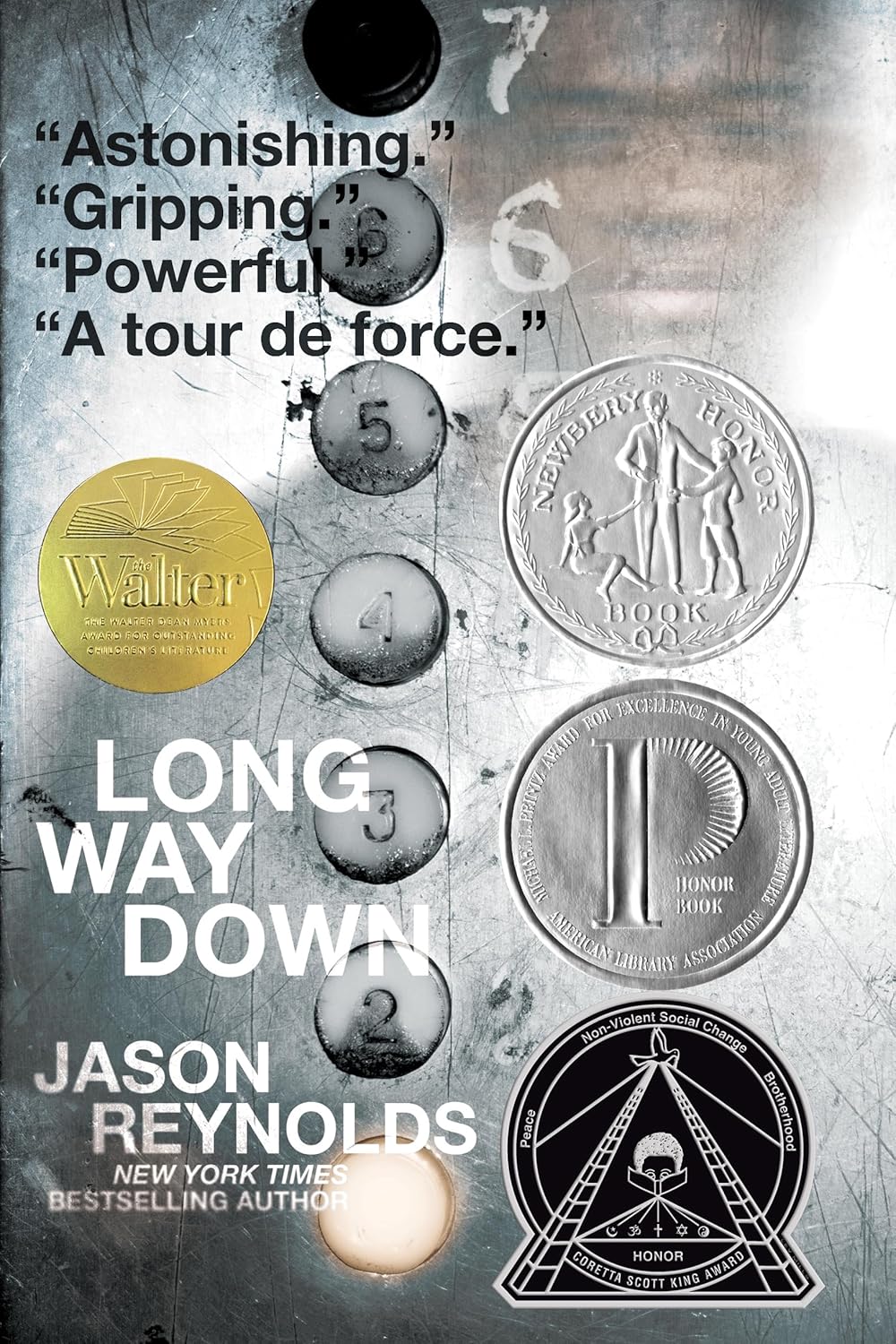
This complete guide to Long Way Down by Jason Reynolds covers everything parents, teachers, and students need to know — from reading level and recommended age to a full character and ghost list, key themes, and similar books. Published in 2017 by Atheneum Books for Young Readers, Long Way Down is a novel written entirely in free verse that takes place during a single sixty-second elevator ride. Fifteen-year-old Will’s older brother has just been shot and killed, and Will is riding the elevator down from the seventh floor with his brother’s gun, planning to follow the only rule he’s ever known: get revenge. At each floor, a ghost boards. A Newbery Honor, Coretta Scott King Honor, and Michael L. Printz Honor book, it is one of the most widely recognized and awarded young adult novels of recent years — and one of the most urgently debated. Whether you’re a parent deciding if it’s right for your child, or a teacher planning a unit around it, you’ll find honest, practical guidance here.
For Parents
Long Way Down is a novel in free verse about a fifteen-year-old named Will who is on his way to commit a murder in retaliation for his brother’s death. Over the course of a sixty-second elevator ride, he encounters the ghosts of people from his neighborhood who were killed in the same cycle of violence — people whose stories complicate everything Will thinks he knows about what happened and why. The book deals directly and unflinchingly with gun violence, gang culture, the logic of revenge, and grief. It contains strong language. Common Sense Media recommends it for ages 14 and up. Most schools that assign it do so in grades 8–10, though it appears in some grades 7 classrooms. This is not a book for younger middle schoolers. Parents who read it alongside their teenager — or who simply read it themselves first — will find it prompts some of the most important conversations a family can have.
For Teachers
Long Way Down is one of the most formally inventive texts in the YA canon and one of the most teachable. Its verse structure makes it an ideal mentor text for studying how form and content interact — the white space on each page creates both the silence of grief and the ticking seconds of the elevator ride, and Reynolds’s line breaks are doing as much work as his words. Its moral architecture — a single sustained question about whether Will will pull the trigger, held in tension across the entire book — is equally rich material for discussions of character, consequence, and the social forces that shape individual choices. Many teachers pair it with nonfiction on gun violence, the cycle of retaliation, and urban poverty, or use it alongside the graphic novel adaptation. It is appropriate for grades 8 and above in most school contexts.
Long Way Down at a Glance
Find on Amazon →| Author | Jason Reynolds |
| Published | 2017 (Atheneum/Caitlyn Dlouhy Books) |
| Grade Level | 7–9 (our assessment) |
| Recommended Age | 12–15 |
| Flesch-Kincaid Grade | ~4.3 |
| Word Count | ~10,177 (verse novel — reads in under an hour) |
| Pages | 306 (standard hardcover/paperback) |
| Chapters | No traditional chapters — sections by elevator floor (7 to lobby) |
| Genre | Verse novel / Realistic fiction / Literary fiction |
| Setting | An apartment building elevator; present day; unnamed American city |
| Awards | Newbery Honor (2018); Coretta Scott King Author Honor; Michael L. Printz Honor; Los Angeles Times Book Prize (YA); Walter Dean Myers Award; National Book Award longlist selection |
For official Lexile and AR levels, visit Lexile.com or AR BookFinder. ReadingVine provides independent editorial assessments.
What Reading Level Is Long Way Down?
Long Way Down carries a Lexile score of HL720L and an ATOS (Accelerated Reader) level of 4.3, worth 2 AR points. The HL prefix on the Lexile score is critical to understand: it stands for High Interest/Low Lexile, a designation used for books whose content complexity and intended audience significantly exceed what the word-level metrics would suggest. A plain 720L score would indicate a book appropriate for around 5th grade by reading level. The HL designation signals that this is not that book — it is a book for high-interest older readers that happens to use accessible language. The ATOS level of 4.3 similarly reflects only the vocabulary and sentence structure of the verse, not the conceptual and emotional demands of the content.
The deeper complication with Long Way Down is its form. The book is 306 pages and contains approximately 10,000 words — a full-length novel’s page count with a short story’s word count. Every page is a poem. Every line break is a choice. White space does as much work as language. A reader can finish it in under an hour, and almost everyone does; the sixty-second elevator premise and the cliffhanger structure make it nearly impossible to stop. But reading it fast and reading it well are different things. Reynolds is operating at a level of formal sophistication — using line breaks, white space, stanza structure, repetition, and sound to construct meaning — that rewards rereading and close attention in ways that a surface race through will miss entirely. The word-level metrics tell you nothing useful about this book.
Our editorial assessment is grades 7–9, with grade 8 being the most common and appropriate assignment level. The publisher’s interest level is grades 7–12. Teachers who assign it in grade 7 typically do so with significant scaffolding and parental notification. For official Lexile and AR scores, visit Lexile.com or AR BookFinder. ReadingVine’s assessments are independent editorial evaluations.
What Age Is Long Way Down Appropriate For?
We recommend Long Way Down for readers ages 12–15. Common Sense Media recommends it for ages 14 and up, which is the more cautious and defensible recommendation for families who want to err on the side of preparation. Reynolds wrote the book partly out of his own experience: when he was nineteen, a close friend was murdered, and he and his friends made plans to seek revenge — plans that only fell apart because the perpetrator couldn’t be conclusively identified. He has said he looks back on that and recognizes how lucky he was. Long Way Down is his attempt to put readers inside that sixty-second window of decision-making before a choice is made that can’t be unmade.
The novel’s entire plot revolves around gun violence and the logic of revenge. Multiple characters have been shot and killed, and their deaths are described — some in detail — as each ghost boards the elevator. Will is carrying a loaded gun with the stated intention of killing someone. The novel’s central moral question is whether he will go through with it; the ending is deliberately ambiguous. Strong language is present throughout, including uses of “s–t,” “f—-rs,” “a–hole,” and several compound phrases. Ghost characters smoke cigarettes on the elevator, and drug dealing is referenced as part of the neighborhood’s economy. There is no sexual content beyond a passing reference to teenage boys bragging about their experiences with girls. There is no graphic gore, but death by gunshot wound is the book’s constant backdrop and subject matter. Parents should be aware that the ambiguous ending — Reynolds does not tell readers whether Will pulls the trigger — is part of the book’s design, not an oversight.
It is worth noting that Reynolds has been explicit about his purpose: this book is for the teenagers who are actually living inside decisions like Will’s, or who know someone who is. He believes these readers deserve fiction that treats their reality with complete seriousness rather than resolving it tidily. For readers who are not in proximity to gun violence — who encounter it as a news story rather than a neighborhood fact — the book functions as an act of radical empathy, placing them inside a perspective they would otherwise never inhabit. Both uses are legitimate. Both require readers who are ready for the weight of what Reynolds is putting on the page.
What Is Long Way Down About?
Will is fifteen years old. His older brother Shawn was shot dead in the courtyard of their apartment building the night before. In their neighborhood, there are three rules — rules nobody invented, that have just always existed: no crying, no snitching, get revenge. Shawn was the one who taught them to Will. Now Will has Shawn’s gun tucked in his waistband, and he is riding the elevator from the seventh floor to the lobby. He knows who he thinks did it. He knows what he is going to do. The ride takes sixty seconds.
At the seventh floor, the doors open and Buck gets on. Buck has been dead for six years, shot when Will was nine. Buck knew the rules too. At the sixth floor, Dani boards — a girl from the playground who was killed by a stray bullet when Will was eight and tried, too late, to shield her. At the fifth floor, and the fourth, and the third, more people get on. Some of them Will knew. Some he knew only by reputation. All of them died by gun violence. All of them have something to tell him about the story he thinks he knows — the story of why Shawn died, who did it, and what Will owes his brother’s memory. By the time the elevator reaches the lobby, Will knows things he didn’t know when he got in. Whether that knowledge changes what he does when the doors open is a question Reynolds leaves, deliberately, unanswered.
Long Way Down Characters
Is Long Way Down Banned?
Long Way Down has been challenged in some schools and libraries, primarily for its depictions of gun violence and its strong language. It has not appeared on the American Library Association’s annual list of the ten most challenged books, but individual challenges have been documented, and it carries the kind of content — gun violence as central subject, moral ambiguity as deliberate design — that makes it a target in climates of heightened book scrutiny.
It is worth understanding the broader context. Jason Reynolds is among the most challenged authors in the country. Two of his other books — All American Boys (co-written with Brendan Kiely) and Stamped: Racism, Antiracism, and You (co-written with Dr. Ibram X. Kendi) — appeared on the ALA’s Top 10 Most Challenged Books list in 2020, challenged primarily for their treatment of racism and police violence. Reynolds was named the inaugural Honorary Chair of Banned Books Week in 2021 precisely because he had become a focal point in debates about what young people should be allowed to read. He has consistently argued that censoring books about gun violence and racism does the most harm to the young people who most need to see their experiences reflected in literature — the very readers he writes for.
Long Way Down remains widely available in school and public libraries across the country, continues to appear on state and national reading lists, and is regularly assigned in grades 8–10 English and humanities classrooms.
Long Way Down Themes and Lessons
The novel’s central preoccupation is the machinery of inherited codes — the way a set of rules (“no crying, no snitching, get revenge”) can be passed from one generation to the next with such momentum and such apparent logic that it never gets examined. Each ghost on the elevator represents a link in the chain: someone who followed the rules, or whose death followed from someone else following the rules, and who is now in a position to show Will that the chain extends further back than he knew and has claimed more people than he understood. Reynolds is not arguing that Will is stupid for being where he is. He is arguing that the rules are a kind of gravity — and that the only way to escape gravity is to know it’s there.
Running alongside this is the novel’s formal argument: that the verse structure, the white space, the sixty-second time frame, and the ambiguous ending are not stylistic choices but ethical ones. Reynolds has said that he deliberately did not resolve the novel because the question of what Will does when the elevator opens is not his to answer — it belongs to the reader, to the fifteen-year-old sitting with the book on their lap, who knows better than Reynolds does what that lobby feels like. The form of the novel is an act of respect for the reader’s autonomy. Discussion questions worth exploring: What does each ghost add to Will’s understanding of his situation — and why does the order in which they board matter? What do “the rules” provide for the people who follow them, and what do they cost? If you were Will, standing in that lobby with the doors about to open, what would you do?
How Many Pages Is Long Way Down?
Long Way Down is 306 pages in the standard hardcover and paperback editions, but page count is one of the least useful measures of this particular book. It is a verse novel, and the majority of each page is white space. The complete word count is approximately 10,000 words — about the length of a long short story. Most readers finish it in under an hour, and many finish it in a single sitting they did not intend to begin. The elevator premise creates a reading experience that is almost physically difficult to pause: each floor stop functions like a chapter break, but the momentum rarely lets a reader stay stopped.
There are no traditional chapters. The novel is structured by elevator floor, descending from 7 to L (lobby), with each floor introducing a new ghost and a new piece of the story Will doesn’t know. For classroom use, the floor structure provides a natural discussion framework: teachers can assign one or two floors per session and use each ghost’s arrival as a focal point for examining what the reader (and Will) now knows that they didn’t know before. The verse form also makes Long Way Down among the best available mentor texts for studying free verse poetry in the context of YA fiction — how line breaks create rhythm, how white space creates silence and dread, how sound patterns reinforce meaning. A graphic novel adaptation illustrated by Danica Novgorodoff was published in 2022 and covers the same story with ink-and-watercolor illustrations. The audiobook, read by Reynolds himself, runs approximately 65 minutes and is widely considered one of the finest audiobook performances in recent YA publishing.
Books Similar to Long Way Down
About Jason Reynolds
Jason Reynolds was born on December 6, 1983, in Washington, D.C., and grew up just across the Maryland border in Oxon Hill. He began writing poetry at nine years old after becoming captivated by the rhythm and lyrics of rap music — particularly Queen Latifah’s 1993 album Black Reign. He has described how he stopped reading books for years as a child because he couldn’t find any that felt relevant to his life in a poor Black community, and he didn’t read a complete novel until age seventeen, when Richard Wright’s Black Boy finally broke through. He spent the next two decades focused on poetry before publishing his first novel, When I Was the Greatest, in 2014. Long Way Down (2017) emerged partly from Reynolds’s own experience: at nineteen, a close friend was murdered, and Reynolds and his friends planned revenge that never materialized only because the killer could not be conclusively identified. He has said he spent years looking back at that and understanding how lucky that was. The novel was a finalist for the National Book Award, a Newbery Honor book, a Coretta Scott King Honor book, and a Printz Honor book — four of the most significant recognitions in American children’s and young adult literature, awarded to the same title in the same year, a remarkable achievement. Reynolds served as the Library of Congress’s National Ambassador for Young People’s Literature from 2020 to 2022, with the platform “Grab the Mic: Tell Your Story.” In 2024, he was named a MacArthur Fellow. He lives in Washington, D.C.
Long Way Down: Frequently Asked Questions
What reading level is Long Way Down?
Long Way Down has a Lexile score of HL720L and an ATOS level of 4.3. The HL prefix is essential context: it stands for High Interest/Low Lexile, a designation for books whose content complexity and intended audience significantly exceed what the word-level metrics suggest. The ATOS of 4.3 reflects only the vocabulary and sentence structure of the verse — it tells you nothing about the content, the formal sophistication, or the emotional demands of the book. Our editorial assessment is grades 7–9. This is not a book for elementary readers, regardless of what the numbers say.
What does the ending of Long Way Down mean?
Reynolds deliberately does not tell readers what Will does when the elevator reaches the lobby. The novel ends with the doors opening and Will stepping out — and nothing more. This is intentional: Reynolds has explained that the decision belongs to the reader, not to him. Some readers interpret the ending as hopeful — that Will’s encounters with the ghosts have changed him enough to stop. Others read it as tragic — that the momentum of the rules is too powerful to break. Both readings are supported by the text. The ambiguity is the point: Reynolds is asking readers to finish the story themselves, which means deciding what they believe about whether people can step outside the cycles they’ve inherited.
How long does it take to read Long Way Down?
Most readers finish Long Way Down in under an hour. Despite being 306 pages, the book contains approximately 10,000 words — about the length of a long short story — because it is written entirely in free verse, with most of each page occupied by white space. The sixty-second elevator premise and the ghost-per-floor structure make it extraordinarily hard to stop reading. Many readers describe finishing it in a single unplanned sitting. Teachers often assign it as a one-night or one-class-period read, then spend multiple sessions on close reading and discussion.
Is Long Way Down appropriate for 7th grade?
For most seventh graders, it is at the edge of appropriateness — possible, but requiring careful consideration. The reading level is low (HL720L, ATOS 4.3), so the prose presents no difficulty. The content — gun violence as central subject, multiple deaths described, strong language throughout, and a fifteen-year-old protagonist on his way to commit a murder — is better suited to eighth grade and above. Teachers who assign it in seventh grade typically do so with parent notification, with significant classroom support, and in contexts where the students’ maturity and the surrounding curriculum can hold what the book opens up. Common Sense Media recommends ages 14 and up.
Is there a graphic novel version of Long Way Down?
Yes. A graphic novel adaptation illustrated by Danica Novgorodoff was published in 2022 by Atheneum/Caitlyn Dlouhy Books. Novgorodoff’s ink-and-watercolor illustrations received five starred reviews and are widely praised for matching the emotional register of Reynolds’s verse — her images bleed at the edges like the story’s violence bleeds through generations. The graphic novel carries its own Lexile score of HL630L and is rated for ages 13 and up. It covers the same story and maintains the ambiguous ending. Some teachers use it alongside the verse novel for visual learners or as an entry point for students who are intimidated by poetry.
What are “The Rules” in Long Way Down?
The Rules are the unwritten code of Will’s neighborhood, passed down through generations without anyone knowing exactly where they started: No. 1 — No crying. No matter what. No. 2 — No snitching. No matter what. No. 3 — Revenge. Do. No matter what. Shawn taught them to Will. Buck taught them to Shawn. Someone taught them to Buck. The novel’s central argument is that the rules have a logic and even a compassion at their origin — they exist to protect people in communities where institutions have failed — but that they also perpetuate the violence they were designed to manage. Each ghost on the elevator is, in different ways, a consequence of The Rules.
Why did Jason Reynolds write Long Way Down?
Reynolds has been direct about his inspiration. When he was nineteen, a close friend was murdered, and Reynolds and his friends planned revenge — plans that only fell apart because the killer couldn’t be conclusively identified. He has said he spent years afterward understanding how lucky that was. Long Way Down is his attempt to put readers inside the sixty seconds before a choice like that is made — not to condemn Will for what he’s thinking, but to make visible the logic that brings someone to that elevator, and to ask whether there is anything that can interrupt it. Reynolds has also said the book is for the young people who are living versions of Will’s situation right now, and who deserve fiction that does not look away from what their lives actually contain.
Has Long Way Down been banned?
Long Way Down has been challenged in some schools and libraries for its gun violence content and strong language. It has not appeared on the ALA’s annual Top 10 Most Challenged Books list, though it has faced individual challenges. Reynolds’s other books — particularly All American Boys and Stamped — have been among the most challenged in the country. Reynolds was named the inaugural Honorary Chair of Banned Books Week in 2021 and has spoken extensively about the harm done when books about the realities faced by Black teenagers are removed from the shelves those teenagers use. Long Way Down remains widely available and continues to be assigned in schools across the country.