
 = Partner Site
Looking for Alaska Reading Level: A Complete Guide
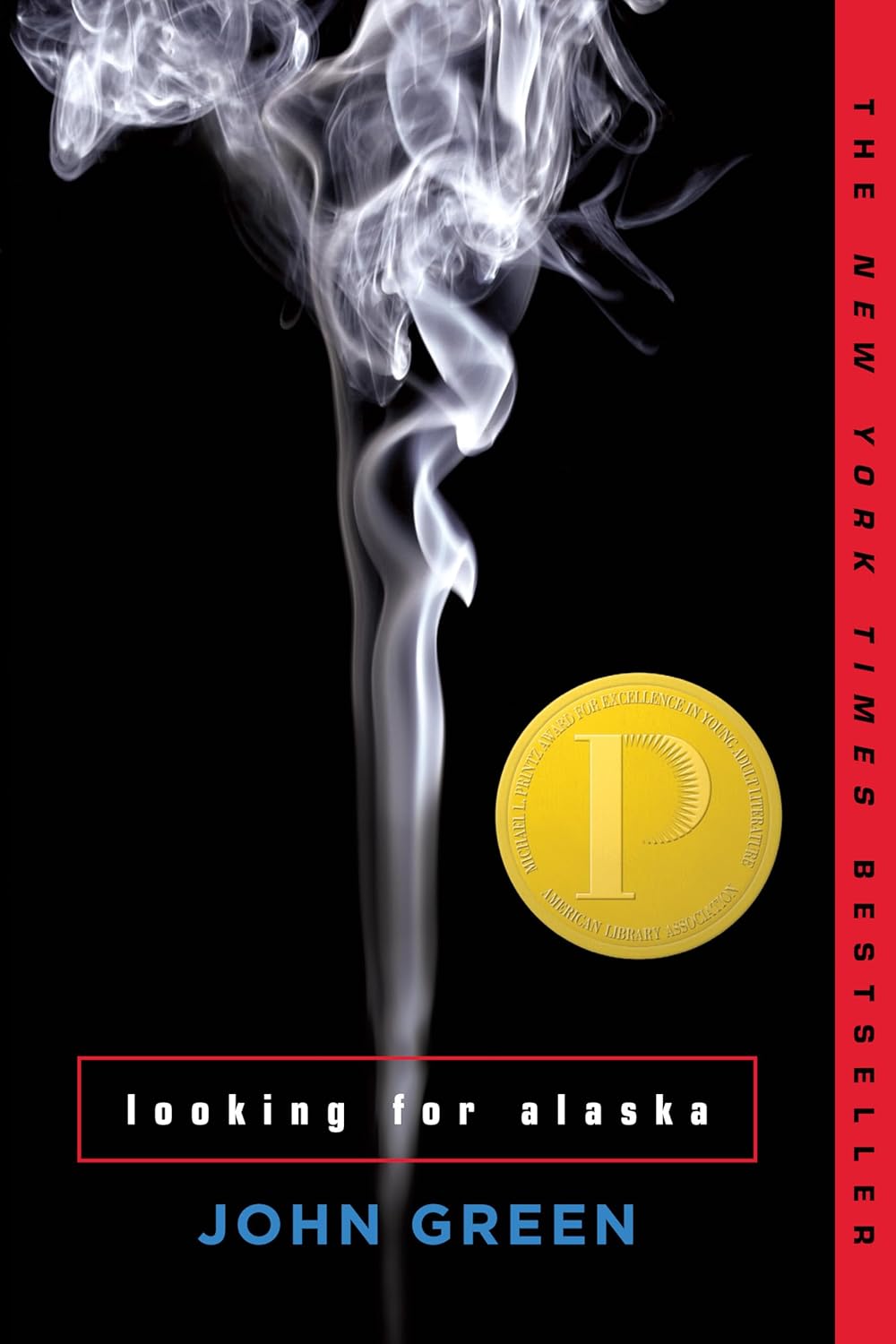
Looking for Alaska by John Green is a novel about Miles “Pudge” Halter, a sixteen-year-old who leaves his Florida home for Culver Creek Preparatory School in Alabama, where he meets Alaska Young — brilliant, self-destructive, and impossible to look away from — and where his life is divided into a Before and an After by something he did not see coming. Published in 2005 and winner of the Michael L. Printz Award, it was Green’s debut novel and the book that established the literary and thematic concerns he would return to across his career: last words, the Great Perhaps, what we owe the dead, and what the living do with grief that cannot be resolved. This complete guide covers Looking for Alaska‘s reading level, recommended age, content considerations, characters, themes, and books similar to Looking for Alaska, designed for parents, teachers, and students.
For Parents
A coming-of-age novel about a boarding school friendship group navigating grief, first love, smoking, drinking, drugs, and the death of a teenage girl — structured in two halves around that death. Contains an oral sex scene and frank depictions of teenage drinking and drug use. Appropriate for ages 14 and up; most commonly assigned in grades 9–11.
For Teachers
An excellent grades 9–11 text for teaching narrative structure, the labyrinth-of-suffering theme, and how grief changes the way we understand what came before it. The novel’s two-part structure — Before and After — is a clean and teachable formal device for discussing how an ending reframes a beginning. John Green’s response to the book’s ban history is unusually articulate and makes the novel productive for discussions of censorship and context alongside its literary content.
Looking for Alaska at a Glance
Find on Amazon →| Author | John Green |
| Published | 2005 (Dutton Books) |
| Grade Level | 9–11 (our assessment) |
| Recommended Age | 14+ |
| ATOS Reading Level | 5.8 |
| Lexile | 850L |
| Word Count | 69,023 |
| Pages | 240 (original); 272 (updated edition with reader’s guide) |
| Structure | Two parts: Before and After; no numbered chapters |
| Genre | Young adult / coming-of-age |
| Setting | Culver Creek Preparatory School, Alabama; mid-2000s |
| Awards | Michael L. Printz Award (2006) |
For official Lexile and AR levels, visit Lexile.com or AR BookFinder. ReadingVine provides independent editorial assessments.
What Reading Level Is Looking for Alaska?
Looking for Alaska has an ATOS reading level of 5.8 and a Lexile of 850L. These scores are reasonably accurate to the prose — Green writes in accessible, contemporary American YA style: first-person narration with natural dialogue, moderate sentence complexity, and no unusual vocabulary demands. The reading challenge is not lexical but emotional and structural: the novel requires sustained engagement with grief, culpability, and the question of whether a person who is clearly self-destructive can be saved by other people’s love for them.
The novel’s two-part structure — “Before” and “After,” divided by Alaska’s death — is its most significant formal feature, and it asks the reader to do specific cognitive and emotional work: to read the Before knowing something is coming, and the After knowing what was lost. This is not a difficult technique to explain, but it is one that rewards thoughtful instruction and makes the novel particularly well-suited to classroom discussion of how form and content interact. At 69,023 words and 240 pages, most readers finish it in two or three sittings; classrooms typically complete it in two weeks. For official Lexile and AR scores, visit Lexile.com or AR BookFinder. ReadingVine’s assessments are independent editorial judgments.
What Age Is Looking for Alaska Appropriate For?
We recommend Looking for Alaska for readers ages 14 and up. The novel contains frank depictions of teenage smoking, drinking, and drug use (marijuana); profanity; and sexual content including an oral sex scene. Alaska’s death involves drunk driving and is ambiguous as to whether it was intentional, which gives the novel a sustained engagement with grief, guilt, and possible suicide that requires emotional maturity. The publisher’s own age recommendation is 14 and up, grade 9 and up, which aligns with our assessment.
The novel’s most-challenged element is a scene in which Miles and his girlfriend-of-one-day Lara engage in oral sex. Green has been unusually transparent about this scene’s purpose: it is deliberately written as awkward, unerotic, and emotionally empty, and is immediately contrasted with a subsequent scene between Miles and Alaska in which there is much less physical intimacy but far more genuine emotional connection. The novel is using the contrast to argue that physical intimacy without emotional closeness is hollow — not endorsing or glamorizing the act. The scene is not graphic but is direct. Beyond the sexual content: the novel depicts teenage drinking and drug use with the same realism it applies to everything else — not glamorizing it, but not pretending it does not happen. Alaska’s death occurs while she is driving drunk; the question of whether it was accidental or intentional is part of the novel’s sustained engagement with grief, guilt, and uncertainty. This is content parents should read and discuss rather than either dismiss or use as grounds for removal.
What Is Looking for Alaska About?
Miles Halter is obsessed with famous last words. His hobby is collecting them: the final utterances of writers, scientists, and philosophers as they approached death. Seeking, as François Rabelais called it, the “Great Perhaps,” he leaves his uneventful Florida high school for Culver Creek Preparatory School in Alabama, where he hopes his life will finally begin. He is placed in a room with Chip “the Colonel” Martin, who becomes his closest friend and guide to the school’s social landscape.
Through the Colonel, Miles meets Alaska Young: beautiful, voracious, unpredictable, funny, and carrying something painful that she periodically mentions and then deflects. She reads everything. She smokes constantly. She introduces Miles to the pranking tradition of the school and to the social circle of smokers who gather behind the gym. Miles falls in love with her immediately, in the way that teenagers fall — completely, without proportion — and spends the first half of the novel watching her be with other people while loving her himself.
The Before section of the novel covers roughly four months of boarding school life: pranks, classes, drinking, smoking, studying, conversations about suffering and God and literature. The Colonel has a complicated home life he is managing from a distance. Alaska has a boyfriend at another school she is occasionally loyal to. Miles is finding his footing in a world that feels, finally, like the one he was meant to be in. Then a night of drinking ends with Alaska receiving a phone call, becoming hysterical, and leaving campus in her car. Miles and the Colonel set off fireworks to distract the dorm monitors so she can get out. The next morning, a teacher tells them that Alaska is dead. She drove into a police car on a rural highway in the middle of the night. The police officer is fine. Alaska is not.
The After section is about grief — about what Miles and the Colonel do with the guilt of having let her go, the question of whether she meant to die, and the question of how you find meaning in a death that may have been meaningless. They investigate obsessively. They eventually arrive at a partial answer that is not a resolution but is enough to let them move forward. The novel ends with Miles’s final paper for his religion class, in which he writes about the labyrinth of suffering — Alaska’s metaphor for the human condition — and how he intends to find his way out of it.
Looking for Alaska Characters
Is Looking for Alaska Banned?
Looking for Alaska was the #1 most challenged book in the United States in 2015, according to the ALA. It has appeared on the ALA’s most challenged list in 2012, 2013, 2014, 2015, 2016, and 2022. It was the fourth most challenged book in the United States between 2010 and 2019. Reasons cited across challenges include sexually explicit content, offensive language, drugs and alcohol, and LGBTQ+ content. The primary driver of most challenges has been the oral sex scene.
Green responded to the challenges directly and at length on his YouTube channel in a video he titled “I Am Not a Pornographer.” His argument: the scene is deliberately written as awkward, unerotic, and emotionally empty, and is immediately contrasted with a more emotionally intimate but far less physically explicit scene — the novel’s argument being that physical intimacy without emotional connection is hollow. “Text is meaningless without context,” he said, “and what usually happens with Looking for Alaska is that a parent chose one particular page of the novel to an administrator.” He ended the video: “If you have a worldview that can be undone by a novel, let me submit that the problem is not with the novel.”
Specific removals include Knox County and Sumner County, Tennessee, where it was removed from required reading lists in 2012 and 2013; Depew, New York, where it was retained but parental permission letters were sent in 2008 and 2009; and Verona, New Jersey, where a parent challenged its inclusion in the high school curriculum. In Marion County, Kentucky, it was challenged in a 12th-grade classroom in 2016 and ultimately retained. The novel has not been formally challenged in recent years at the same frequency as *Perks*, partly because it lacks the childhood sexual abuse element that drives *Perks*’s recent challenge activity.
Looking for Alaska Themes and Lessons
The novel’s central philosophical question is borrowed from Alaska, who borrows it from Simón Bolívar: how do you get out of the labyrinth of suffering? Alaska has her own answer — “straight and fast” — which in retrospect may be a description of how she died. Miles arrives at a different answer in the novel’s final pages, in his religion class paper: by forgiving, by continuing, by refusing to let the labyrinth be the last word. The question connects everything in the novel — Miles’s love for famous last words is a form of asking the same thing, and the religion class’s survey of world traditions is another — and gives Green’s coming-of-age story a philosophical ambition that distinguishes it from the grief YA that followed in its wake.
The Before/After structure is the novel’s formal argument about grief: the Before section reads differently once you have finished the After. On first reading, the Before is a high school novel about pranks and first love; on second reading, it is full of foreshadowing — moments where Alaska’s self-destruction and her guilt about her mother were visible, if anyone had been paying close attention. The question of whether Miles should have seen it coming, and whether seeing it would have changed anything, is the question that drives the After investigation and that the novel does not fully resolve. This irresolution is the novel’s most honest quality: grief cannot be resolved, only survived.
Alaska herself is the novel’s most complex and most deliberately incomplete portrait. Green has said that he wanted to write a character who was fully realized from Miles’s perspective — intensely observed, deeply felt — while remaining genuinely unknowable. Alaska’s interiority is never directly available to the reader because Miles can only see her from the outside, and his love for her is in part a love for his own image of her rather than for who she actually is. The After section’s discovery that he did not fully know her is not a disillusionment but a deepening: she was more than he imagined, and her death is more complicated than a simple accident or a simple choice.
Discussion questions for classrooms and families: What does it mean to look for the “Great Perhaps” — and does Miles find it? What is Alaska’s answer to the labyrinth question — and what is Miles’s? How does the novel’s Before/After structure change the way you read the Before section once you have finished the After? Is the novel arguing that Miles could have saved Alaska — or that no one could have? What does Green mean when he says the oral sex scene exists to contrast with what follows it?
How Many Pages and Chapters in Looking for Alaska?
The original Dutton Books paperback is 240 pages; the updated edition with a reader’s guide runs 272 pages. The novel has no numbered chapters — it is structured as a series of dated sections, each titled with a countdown to or countup from Alaska’s death: “one hundred thirty-six days before,” “one hundred and twenty-two days before,” down to “the last day,” then “the day after,” “two days after,” and forward. Word count is 69,023. Most readers finish it in two or three sittings; classrooms typically complete it in two weeks.
The countdown structure — “one hundred thirty-six days before,” declining toward zero and then counting up after — is both a narrative device and a thematic argument: it places the reader in the position of knowing that something is coming without knowing what, and of counting down toward it. This creates a specific kind of dramatic irony that shapes the entire Before section, turning what would otherwise be a fairly conventional boarding school narrative into something that accumulates dread beneath its comedy and warmth. It is a structure worth discussing with students before reading begins.
Books Similar to Looking for Alaska
About John Green
John Green was born in 1977 in Indianapolis, Indiana. He studied English and Religious Studies at Kenyon College, and worked briefly as a student chaplain at a children’s hospital in Ohio before beginning his writing career — an experience he has credited as transformative in his understanding of how people approach mortality and meaning. He wrote Looking for Alaska over a period of roughly six years, beginning in college and finishing in 2004, when it sold to Dutton Books. The Printz Award arrived the following year.
Green is one of the most commercially successful and most challenged YA authors in the history of the category. His subsequent novels include An Abundance of Katherines (2006), Paper Towns (2008), The Fault in Our Stars (2012) — which sold over ten million copies — and Turtles All the Way Down (2017). He created the online educational video series CrashCourse with his brother Hank Green, and the two run the VlogBrothers YouTube channel with millions of subscribers. The 2012 and 2019 Hulu adaptations of Looking for Alaska (Hulu released an eight-episode limited series in 2019) were received warmly by fans, with the Hulu version widely considered faithful to the novel’s emotional texture.
Green has spoken and written extensively about Looking for Alaska‘s ban history, consistently arguing that the challenges misrepresent the book by extracting context from content. His video response — “I Am Not a Pornographer” — has been widely shared in intellectual freedom advocacy contexts. He lives in Indianapolis with his family.
Looking for Alaska: Frequently Asked Questions
What reading level is Looking for Alaska?
Looking for Alaska has an ATOS reading level of 5.8 and a Lexile of 850L. These scores accurately reflect the accessible YA prose. The primary challenge is emotional and structural — the Before/After structure, the grief, the ambiguity of Alaska’s death — rather than linguistic. Our editorial assessment places it at grades 9–11, ages 14 and up, consistent with the publisher’s own age recommendation. For official Lexile and AR scores, visit Lexile.com or AR BookFinder.
What grade is Looking for Alaska appropriate for?
We recommend grades 9–11, ages 14 and up — consistent with the publisher’s rating of Grade 9+. The novel contains an oral sex scene, frank depictions of teenage drinking and drug use, profanity, and a death that may have been intentional. The publisher and Dutton Books rate it 14 and up, Grade 9 and up.
How many pages are in Looking for Alaska?
The original Dutton Books paperback is 240 pages; the updated edition with a reader’s guide is 272 pages. Word count is 69,023. Most readers finish it in two or three sittings; classrooms typically take two weeks.
What is Looking for Alaska about?
Miles Halter leaves home for Culver Creek Preparatory School in Alabama, where he meets Alaska Young and falls in love with her. The novel’s Before section covers their friendship; the After section covers Miles’s grief and investigation after Alaska dies in a car accident on a rural highway in the middle of the night. The novel’s central question — whether Alaska’s death was an accident or a choice, and what either answer means — is never fully resolved.
Does Alaska die in Looking for Alaska?
Yes — and the novel announces this from its first pages through the countdown structure, so it is not a spoiler in the conventional sense. The novel is organized around Alaska’s death: the Before half builds toward it, and the After half is entirely about Miles’s grief and investigation. The question the novel actually asks is not whether she dies but whether it was an accident or intentional — and the novel does not give a definitive answer.
Why is Looking for Alaska banned?
Primarily because of an oral sex scene between two teenage characters. The scene has been the basis for most formal challenges. John Green has responded that the scene is deliberately awkward, unerotic, and emotionally empty, and is immediately contrasted with a subsequent scene that is more emotionally intimate but less physically explicit — the novel arguing that physical intimacy without emotional connection is hollow. Additional challenge reasons include offensive language, drug and alcohol use, and LGBTQ+ content. It was the #1 most challenged book in the United States in 2015.
What does the Great Perhaps mean in Looking for Alaska?
Miles’s obsession with famous last words leads him to Rabelais, the French Renaissance writer who reportedly said “I go to seek a Great Perhaps” as he was dying. Miles interprets this as a reason to leave home — to seek something larger and less certain than the safe life he has been living. The Great Perhaps becomes the novel’s shorthand for the genuine risk of full engagement with life: seeking something you cannot be certain of finding, knowing the seeking might cost you something.
Is there a Looking for Alaska TV series or movie?
Hulu released an eight-episode limited series adaptation in October 2019, starring Charlie Plummer as Miles and Kristine Froseth as Alaska. The series was written by Josh Schwartz and Stephanie Savage and is generally considered faithful to the novel’s emotional tone. It is rated TV-MA and is appropriate for the same age range as the novel. No theatrical film adaptation has been made.