
 = Partner Site
Messenger Reading Level: A Complete Guide
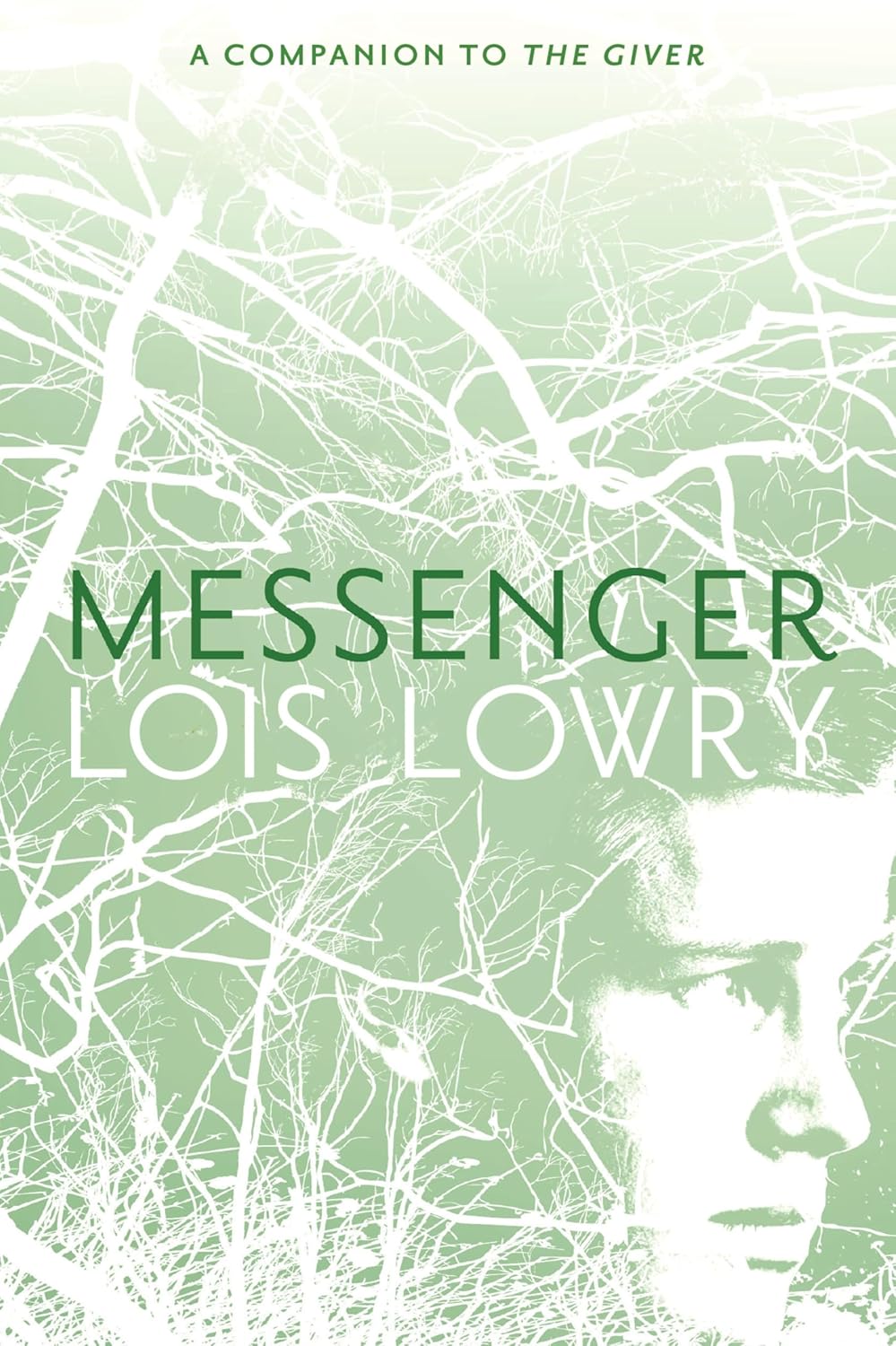
Messenger by Lois Lowry is the third book in the Quartet that began with The Giver and continued with Gathering Blue — a shorter, darker, and more urgent novel that brings the two previous books’ worlds into contact and asks what happens to a community when the values that founded it begin to erode. Narrated by Matty, a young boy who appeared briefly in Gathering Blue and who has grown up in Village, a place of radical welcome that takes in outcasts and refugees from other communities, Messenger is a novel about the specific corruption that comfort produces, about the cost of closing doors that were once open, and about what it means to spend yourself completely in service of something larger than yourself. This complete guide covers the reading level, age appropriateness, themes, characters, and everything parents and teachers need to know about this essential third installment.
For Parents
Messenger is the darkest of the Quartet’s first three books — a novel whose central event is a sacrifice, whose world is literally being poisoned by its inhabitants’ growing selfishness, and whose ending is moving in the specific way of stories that do not flinch from what courage actually costs. Best suited for readers ages 10-13, it is short and fast-moving, and parents who have read The Giver and Gathering Blue with their children will find it the most emotionally intense of the three. It can also be read independently, though it is most rewarding as part of the sequence.
For Teachers
Well suited to grades 5-7, Messenger is an exceptional text for teaching sacrifice as a narrative and philosophical concept, the relationship between individual integrity and community health, and how authors use physical metaphor — the Forest’s encroachment, the traded objects’ corruption — to make abstract moral decay legible. It also brings the Quartet’s two previous narrative threads together in ways that reward students who have read both and that raise productive questions about how a series can expand and deepen its world across multiple volumes.
Messenger at a Glance
Find on Amazon →| Author | Lois Lowry |
| Published | 2004 |
| Grade Level | 5-7 (our assessment) |
| Recommended Age | 10-13 |
| Flesch-Kincaid Grade | 4.8 |
| Word Count | ~37,000 |
| Pages | 169 (standard paperback) |
| Chapters | 20 |
| Genre | Dystopian fiction / fantasy |
| Setting | Village and the Forest, the same world as The Giver and Gathering Blue |
| Awards | ALA Notable Children’s Book |
For official Lexile and AR levels, visit Lexile.com or AR BookFinder. ReadingVine provides independent editorial assessments.
What Reading Level Is Messenger?
Messenger reads at approximately a 5th-7th grade level by our editorial assessment, with a Flesch-Kincaid grade level of around 4.8. That score runs notably low for a novel most associated with grades 5-7 — Lowry writes in Matty’s voice with a directness and urgency that reflects his character: a boy who moves fast, thinks clearly, and does not waste words. The prose is among the most spare in the Quartet, suited to a novel that is the shortest and most compressed of the four and that builds its emotional weight through accumulation rather than elaboration.
What makes the novel more demanding than its word-level score suggests is the philosophical and emotional density of what it is doing. Messenger is a novel about community corruption — about how a place founded on radical welcome can turn inward, selfish, and closed — and the mechanism Lowry uses to render that corruption (the trading of intangible things, the Forest’s physical response to moral decay) requires readers who can hold metaphor and literal narrative simultaneously. The ending, which is the most emotionally intense conclusion in the first three books of the Quartet, asks readers to sit with loss and sacrifice in ways that are demanding regardless of reading level.
The book is most commonly recommended for grades 5-7, and is most rewarding for readers who have read at least one of the previous Quartet novels. For official Lexile and Accelerated Reader scores, visit Lexile.com or AR BookFinder.
What Age Is Messenger Appropriate For?
We recommend Messenger for readers ages 10-13. It is the darkest of the Quartet’s first three installments — not through graphic violence or disturbing imagery, but through the sustained moral weight of its central situation and the genuine cost of its ending.
The Forest is depicted as a malevolent, actively hostile environment that injures and threatens characters throughout the novel — vines that grab, paths that close, a physical world that is responding to moral corruption with increasing hostility. Several characters are killed or seriously harmed by the Forest. The novel’s central sacrifice — Matty’s use of his healing gift to its fullest extent — results in his death, which is the novel’s emotional climax and is handled with grief and dignity rather than shock. Readers who have grown attached to Matty through Gathering Blue will find this ending more affecting; readers encountering him for the first time will still feel its weight. There is a brief, entirely age-appropriate romantic element involving a secondary character. There is no sexual content and no strong language. The novel’s difficulty is entirely philosophical and emotional.
Parents who are reading the Quartet in sequence with their children should be prepared for Messenger to be a more emotionally demanding experience than the first two books — the ending is genuinely moving, and children who have come to care about Matty will feel his sacrifice. The novel handles this with the same care and craft that characterize the entire Quartet, and the ending’s emotional weight is a measure of the quality of what Lowry has built across the three books.
What Is Messenger About?
Matty is a boy of about fourteen who lives in Village — the same place that Kira’s friend Matt traveled to at the end of Gathering Blue, a community founded by a man called Leader on the principle of radical welcome. Village takes in the outcasts, the damaged, the people no other community will have: the blind man Matty calls Seer, who is his guardian; Kira, who has come from her village to live here; and a steady stream of refugees from other places who arrive at Village’s borders and are taken in without question or condition. It has been, since its founding, a place of extraordinary generosity.
But something has been changing in Village. The people who once welcomed strangers with open hands have begun to close them. At the Trade Mart — a market where villagers exchange goods and services — people have started trading not just objects but intangible things: years of life, physical beauty, intelligence, capacity for kindness. They come away from these trades with what they wanted and changed in ways that are difficult to name but immediately visible. The woman who traded away her empathy is harder now, more closed. The man who traded years of his life seems older than he should. And in the communal meetings where Village’s decisions are made, a new mood has taken hold: a vote is coming on whether to close Village’s borders to new arrivals, and the vote, which would have been unthinkable a year ago, looks likely to pass.
The Forest — the dangerous wilderness that surrounds Village and through which Matty has always been able to travel safely, as not everyone can — has been changing too. It is more hostile, more actively malevolent, thicker and more difficult to pass through than it has ever been. And Matty, whose role as Village’s messenger requires him to travel through it regularly, has begun to feel its hostility increasing with each journey.
Matty has also discovered, tentatively and without fully understanding it, that he has a gift: the ability to heal. He has used it twice, small healings that left him weakened and uncertain. He does not know what it costs. He does not know what using it fully would require of him.
The novel’s crisis arrives when Leader sends Matty on a final urgent mission: to travel through the Forest to Kira’s former village and bring her back to Village before the borders close — and before the Forest makes the journey impossible. Matty sets out with Kira’s blind father Seer’s blessing and a growing understanding that this journey will ask everything he has. What happens on that journey, and what Matty does when the Forest finally closes entirely around them, is the novel’s climax — a sacrifice so complete and so clearly chosen that it is one of the most affecting acts of heroism in the Quartet.
Messenger Characters
Is Messenger Banned?
Messenger has not been widely challenged on its own and does not appear regularly on lists of challenged books. It is occasionally caught in challenges directed at The Giver as part of the Quartet, but its own content — the dying Forest, the corrupted village, Matty’s sacrifice — has not generated the specific objections that have sometimes been raised against the first two books. It is widely available and recommended for its age range.
Messenger Themes and Lessons
The central theme of Messenger is what happens to a community when its founding values are traded away for comfort and self-interest — the argument, made through the specific and physical mechanism of the Trade Mart, that the qualities that make a community generous and open are not permanent possessions but ongoing choices that can be surrendered, exchange by exchange, until nothing of the original spirit remains. Village was founded on radical welcome. What the trading has done is replace that welcome with a calculation: is this new arrival worth what they will cost us? The vote to close the borders is the final transaction in a series of smaller ones, each of which seemed reasonable in isolation and each of which contributed to a transformation that none of the individual traders intended.
Gifts and responsibility are the novel’s second great themes, centered on Matty’s healing power. The Quartet is, among other things, a sustained meditation on the relationship between extraordinary gifts and the obligations they carry — Jonas’s capacity to receive memories, Kira’s gift for embroidery, Matty’s ability to heal. In each case the gift is not simply an ability but a claim: it asks something of the person who has it, and the question is whether they will answer that claim or withhold themselves. Matty’s answer is the most complete and most costly in the series, and it is given without hesitation, which is both the most heroic and the most heartbreaking thing about him.
Welcome and exclusion are the novel’s third great themes, and the ones most directly relevant to contemporary discussions about community, immigration, and the specific ways that prosperous communities respond to need from outside their borders. Lowry does not editorialize; she renders. Village’s transformation from a place of welcome to a place of exclusion is shown through specific people making specific choices, and the novel’s argument about what that transformation costs — costs the community, costs the people turned away, costs the individual traders who gave away their capacity for empathy one exchange at a time — is made entirely through narrative rather than argument.
Discussion starters for classrooms: What are the people of Village trading at the Trade Mart, and what do those trades cost them? Why does the Forest respond to what is happening in Village? What is Matty’s gift, and what does using it fully require of him? Why does Matty make the choice he makes at the end? What does Leader’s identity — for readers of The Giver — add to the novel’s meaning? What does Village’s vote to close its borders remind you of in the real world?
How Many Pages and Chapters Are in Messenger?
The standard paperback edition of Messenger is 169 pages, divided into 20 chapters averaging around eight pages each. The word count is approximately 37,000 words — the shortest of the Quartet’s first three novels and the most compressed. Every chapter advances the central tension, and the novel’s final third, in which Matty and Kira make their way through the increasingly hostile Forest, is among the most sustained and most controlled sequences of building dread in middle grade fiction.
For readers in the target age range of 10-13, expect a reading time of roughly 3-4 hours, or about a week of comfortable reading at 30 minutes per session. As a classroom text it works best as the third in a Quartet unit — its resonance depends significantly on knowledge of the previous books, and students who arrive at it having read both The Giver and Gathering Blue will find the connections between the three books one of the richest analytical discussions available at this level. The revelation of Leader’s identity is the Quartet’s most satisfying moment of connection for readers who know the first book, and discussing how Lowry manages that revelation — quietly, without drama, as a detail that lands differently depending on what the reader brings to it — is a productive craft exercise. Son (2012) concludes the Quartet and returns most directly to Jonas’s story.
Books Similar to Messenger
About Lois Lowry
Lois Lowry is one of the most celebrated American children’s authors of the past fifty years, the winner of two Newbery Medals — for Number the Stars (1990) and The Giver (1994) — and the author of more than forty books for young readers. Messenger, published in 2004, was the third book in the Quartet she had begun with The Giver in 1993 and continued with Gathering Blue in 2000. It brought the two previous novels’ worlds into contact for the first time and introduced the sacrifice that is its emotional climax — a moment Lowry has spoken about as having come to her with unusual clarity and completeness, as if the story had always known it would end this way. The Quartet concludes with Son (2012), which returns to Jonas’s story and provides resolution for both narrative threads. Lowry lives in Maine.
Messenger: Frequently Asked Questions
What reading level is Messenger?
Messenger has a Flesch-Kincaid grade level of approximately 4.8, which runs notably low for a novel most associated with grades 5-7 (ages 10-13). Matty’s voice is direct and spare, suited to the novel’s compressed urgency. What makes it more demanding is the philosophical density of the community corruption it depicts, the simultaneous literal and metaphorical register of the Forest’s response, and the emotional weight of its ending. For official Lexile and AR scores, visit Lexile.com or AR BookFinder.
Do I need to read The Giver and Gathering Blue first?
Messenger can be read independently but is most rewarding as the third book in sequence. Readers who come to it without knowing The Giver will find Leader a compelling and somewhat mysterious figure; readers who know the first novel will recognize him immediately, and that recognition is one of the Quartet’s most satisfying payoffs. Readers who have not read Gathering Blue will find Matty somewhat less developed than he is for those who met him there as a child. The novel is complete on its own terms but gives back more to readers who know the ground it is built on.
Who is Leader, and why does it matter?
Leader is the man who founded Village and who governs it at the time of the novel — a figure of moral authority and forward vision who carries a gift of his own. For readers of The Giver, his identity is one of the Quartet’s most significant and most quietly handled revelations: Lowry does not announce it or dramatize it, but places it in the text in a way that lands very differently depending on what the reader brings to it. Discussing how Lowry manages this revelation — the restraint she uses, the trust she extends to readers who know the first novel — is one of the richest craft discussions available across the Quartet.
What is the Trade Mart, and what are people trading?
The Trade Mart is Village’s market, where people exchange goods and services — but it has been corrupted into a place where people also trade intangible qualities: years of life, physical beauty, intelligence, and most significantly the capacities for empathy and generosity that made Village what it was. The traded qualities are real and the loss is real: people who trade away their empathy become measurably less empathetic; those who trade years of their life age faster than they should. The Trade Mart is the novel’s central metaphor for the way a community’s founding values can be surrendered exchange by exchange, each transaction seeming reasonable in isolation and each one contributing to a transformation that no individual trader intended but that all of them together have produced.
Why does the Forest respond to what is happening in Village?
The Forest’s increasing hostility is the novel’s most overtly fantastical element and its central physical metaphor: the natural world responding to the moral corruption of the community within it, as if the two are connected in ways that go beyond the merely symbolic. Lowry does not explain the mechanism — she presents it as simply how this world works. The Forest has always been difficult for most people to traverse, passable only for those with a specific attunement to it. As Village’s moral environment deteriorates, the Forest’s hostility increases, until the journey that Matty has always made safely becomes genuinely deadly. The connection is the novel’s argument made physical: the world is not indifferent to what human communities do with themselves.
What happens to Matty at the end?
Matty uses his healing gift to its absolute fullest extent — healing not just the people around him but the Forest itself, reversing the corruption that Village’s selfishness has produced — and the cost of that complete expenditure is his life. He dies having done the thing his gift was for, entirely voluntarily, with full knowledge of what it will cost. Leader, who can see forward, has known this is coming and has not told Matty, which is one of the novel’s most quietly heartbreaking details. Matty’s death is handled with grief and dignity and without melodrama, and the village’s restoration in the aftermath is the novel’s final image: the thing Matty’s sacrifice made possible, the community returned to what it was founded to be.
What grade is Messenger typically assigned in?
Messenger is most commonly assigned in grades 5, 6, and 7, almost always as part of a Quartet unit that includes at least The Giver. When taught in sequence, it rewards discussion about how a series can expand and deepen its world across multiple volumes, how Lowry uses the revelation of Leader’s identity, and how the three novels’ different portrayals of social control — technological suppression, historical falsification, communal selfishness — illuminate each other. It is also productive for units on sacrifice as a narrative and philosophical concept, and on the relationship between individual choices and community health.