
 = Partner Site
One Crazy Summer Reading Level: A Complete Guide
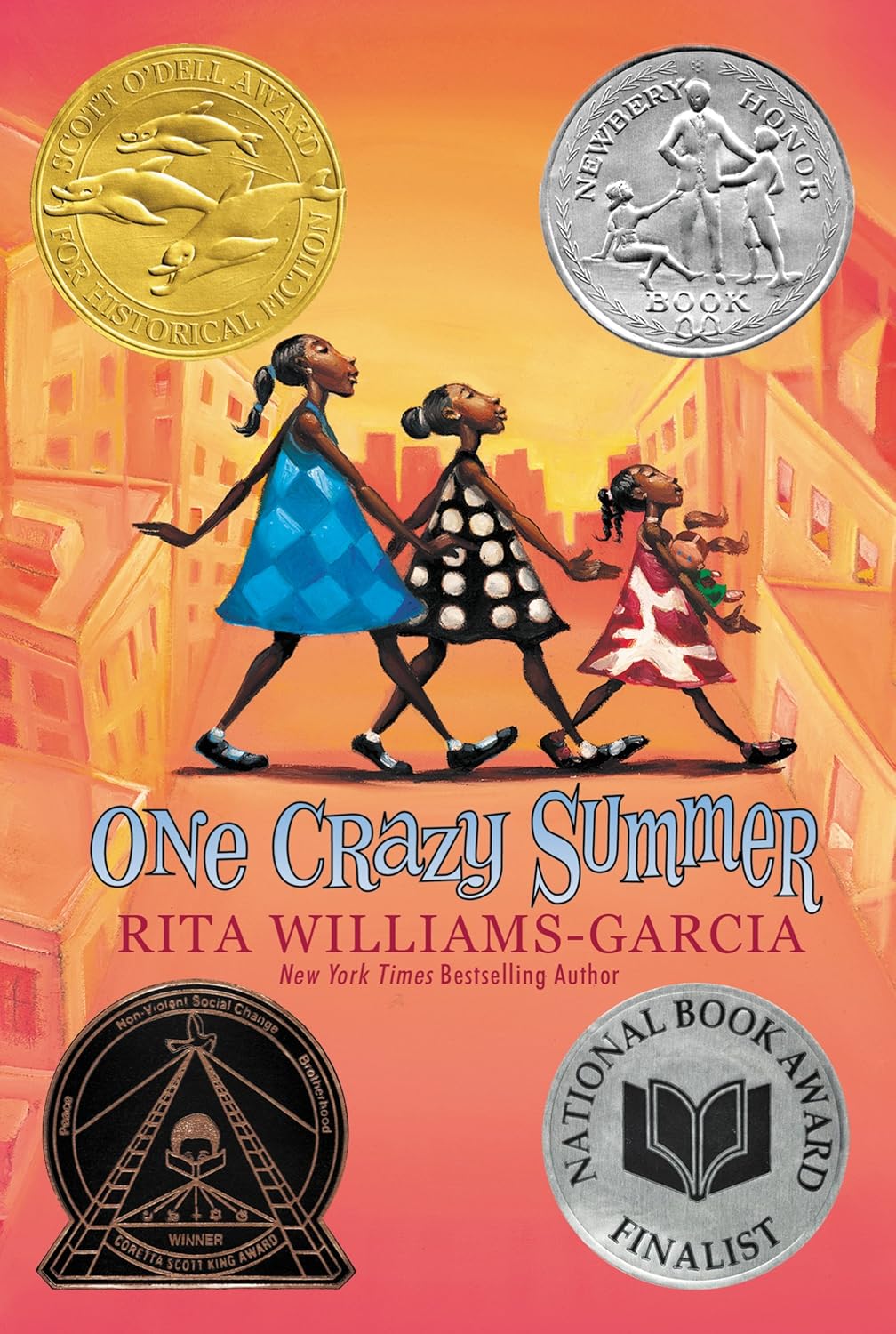
One Crazy Summer by Rita Williams-Garcia is a Newbery Honor-winning novel about three sisters from Brooklyn who travel to Oakland, California, in the summer of 1968 to spend time with the mother who left them years ago — a mother who turns out to be a Black Panther poet with no particular interest in being a mother. Funny, sharp, and deeply moving, it is a novel about family in all its complication, about Black political history, and about three girls figuring out who they are and what they deserve. This complete guide covers the reading level, age appropriateness, themes, characters, and everything parents and teachers need to know about this acclaimed and important novel.
For Parents
One Crazy Summer is a funny, warm, and quietly heartbreaking novel about three sisters navigating a summer with a mother who never wanted to be one. It deals honestly with abandonment, the Black Panther movement, and what children do with a love that isn’t returned the way they need. Best suited for readers ages 9-12, it is one of the most distinctive and beautifully written middle grade novels of the past two decades — and one of the few to give young readers an honest, sympathetic, and humanizing portrait of the Black Power movement.
For Teachers
A Newbery Honor and Coretta Scott King Award winner well suited to grades 4-6, One Crazy Summer is an outstanding text for teaching point of view, limited first-person narration, and how authors render a specific historical moment through a child’s limited but acute perspective. The novel’s 1968 Oakland setting — the Black Panther Party at its height, the assassination of Robert Kennedy in the novel’s opening weeks, the free breakfast programs — makes it an exceptionally rich text for units on the Civil Rights era and Black Power movement. The three-sister dynamic also opens rich discussions of family structure, sibling relationships, and what children are owed by their parents.
One Crazy Summer at a Glance
Find on Amazon →| Author | Rita Williams-Garcia |
| Published | 2010 |
| Grade Level | 4-6 (our assessment) |
| Recommended Age | 9-12 |
| Flesch-Kincaid Grade | 4.8 |
| Word Count | ~42,000 |
| Pages | 218 (standard hardcover) |
| Chapters | 28 |
| Genre | Historical fiction / realistic fiction |
| Setting | Oakland, California, summer 1968 |
| Awards | Newbery Honor (2011); Coretta Scott King Award (2011); Scott O’Dell Award for Historical Fiction (2011) |
For official Lexile and AR levels, visit Lexile.com or AR BookFinder. ReadingVine provides independent editorial assessments.
What Reading Level Is One Crazy Summer?
One Crazy Summer reads at approximately a 4th-6th grade level by our editorial assessment, with a Flesch-Kincaid grade level of around 4.8. The prose is clear and immediate — Williams-Garcia writes in Delphine’s first-person voice with wit and precision, and the voice is one of the great pleasures of the novel. Delphine is eleven years old and narrates with the confidence of a child who has had to be more capable than her years, and her observations about the world around her are consistently funny, sharp, and emotionally true.
What makes the book more demanding than its word-level score suggests is the historical context. The novel is set in Oakland in the summer of 1968 — one of the most politically turbulent summers in American history — and the Black Panther Party is a central presence. The free breakfast programs, the political meetings, the specific vocabulary of Black Power, the assassinations of that year: readers who have some familiarity with the Civil Rights era will get considerably more from the novel, and those who don’t will find the historical content both accessible and illuminating.
The emotional complexity of Cecile — the mother who does not want to be a mother — also asks more of readers than a simpler family story would. Delphine’s narration is funny and competent, but her longing is real and runs underneath every scene. Readers who can hold both the comedy and the ache simultaneously will find the novel deeply rewarding. It is most commonly assigned in grades 4-6. For official Lexile and Accelerated Reader scores, visit Lexile.com or AR BookFinder.
What Age Is One Crazy Summer Appropriate For?
We recommend One Crazy Summer for readers ages 9-12. The novel deals honestly with parental abandonment — Cecile left her daughters when they were very young and has shown no interest in returning — and with the girls’ complicated feelings about a mother who does not love them the way they need to be loved. It also depicts the Black Panther movement with historical sympathy and accuracy.
The central emotional difficulty of the novel is Cecile’s rejection of her daughters — she makes clear, in ways both direct and indirect, that she did not want to be a mother and does not particularly want them in her house. This is handled with honesty and without sentimentality, and the girls’ responses range from denial to anger to a painful acceptance that is one of the novel’s most moving elements. The Black Panther Party is depicted as a community organization running a free breakfast program and political education — not as a violent organization, though the historical context of FBI surveillance and police hostility is present. The assassination of Robert Kennedy is referenced in the novel’s opening. There is no graphic content, no strong language, and no sexual content.
The novel’s treatment of a mother who does not love her children as expected can be particularly resonant for children who have experienced absent or emotionally unavailable parents. It handles this with extraordinary care — never demonizing Cecile, never pretending the girls’ pain is not real, and finding in the situation something true and complicated rather than simple or comfortable.
What Is One Crazy Summer About?
It is the summer of 1968. Eleven-year-old Delphine Gaither is the oldest of three sisters, and she has been the responsible one for as long as she can remember — managing her younger sisters Vonetta and Fern, managing the household, managing the gap left by a mother who walked out years ago. Now their father and grandmother have arranged for the three girls to spend the summer in Oakland, California, with that mother: a woman named Cecile Johnson who goes by the name Nzila and who writes poetry and would very much prefer not to have three daughters turning up on her doorstep.
Cecile is not what the girls expected. She is not warm or welcoming. She does not cook for them — she sends them to the Black Panther free breakfast program every morning for their meals and spends her days at her printing press, writing and printing her poetry. She makes it clear, without quite saying so directly, that she did not want them then and is not entirely sure what to do with them now. Delphine absorbs this with the fierce, competent stoicism of a child who has learned not to need too much. Vonetta, the middle sister, absorbs it with drama and fury. Fern, the youngest, holds on to her doll and watches.
What none of them expected is what they find at the Black Panther community center: other children, a sense of purpose, a way of understanding the world that is different from anything they learned in Brooklyn. The Panthers’ community breakfast program and political education classes give the girls a context for understanding what is happening in America in the summer of 1968 — and for understanding, slowly, something about their mother that they couldn’t have seen from the outside.
Williams-Garcia has spoken about the novel growing from her own experience of the Oakland of that era and her admiration for the Black Panther Party’s community programs, which she felt had been systematically misrepresented in American culture. She wanted to give young readers a portrait of the Panthers that showed what they actually did in communities — feeding children, educating families, building solidarity — rather than the caricature that history often offers.
One Crazy Summer Characters
Is One Crazy Summer Banned?
One Crazy Summer has appeared on challenged book lists in some districts, primarily due to its sympathetic portrayal of the Black Panther Party and its honest depiction of a mother who does not want her children. Challenges have generally come from parents who object to the political content or who feel the family dynamics are inappropriate for the age group. The children’s literature community has broadly and strongly defended the book. It received the Newbery Honor, the Coretta Scott King Award, and the Scott O’Dell Award in 2011, and it is widely used in school curricula across the country.
One Crazy Summer Themes and Lessons
The central theme of One Crazy Summer is what children do when the love they need is not available in the form they need it. Delphine, Vonetta, and Fern each respond to Cecile’s emotional unavailability differently — competence, drama, quiet observation — and the novel honors all three responses as valid ways of surviving a painful situation. None of the girls gets from Cecile what they came for, and the novel’s resolution does not pretend otherwise. What they get instead is something unexpected: a partial understanding of who their mother is, a community that fed them, a summer that changed them. Williams-Garcia suggests that this is sometimes what life offers — not what you needed, but something real nonetheless.
The Black Panther Party is treated as a genuine community institution rather than a political abstraction or a threat. The free breakfast program, the political education classes, the sense of collective purpose — these are depicted with warmth and specificity, and the girls’ engagement with the Panther community is one of the novel’s most important elements. Williams-Garcia is making a clear argument: the Panthers did real work for real people, and children who grew up in Oakland in 1968 experienced them as neighbors and helpers, not as the menacing figures of official history.
Sisterhood is the third major theme — the specific, sustaining love between these three girls, who have held each other together in the absence of the parent who should have done it. The novel is ultimately a love story about three sisters, and their bond is what makes everything else possible.
Discussion starters for classrooms: How does each sister respond to Cecile differently, and what does that tell you about each of them? What did the Black Panther Party actually do for the community in Oakland? How does Delphine change over the course of the summer? What does the novel suggest about what children deserve from their parents? By the end, do you understand Cecile? Do you forgive her?
How Many Pages and Chapters Are in One Crazy Summer?
The standard hardcover edition of One Crazy Summer is 218 pages, divided into 28 chapters averaging around eight pages each. The word count is approximately 42,000 words — on the shorter side for middle grade historical fiction, which gives the novel a brisk, propulsive quality that suits Delphine’s voice perfectly. Despite the short page count, the novel is remarkably dense with character, history, and feeling.
For readers in the target age range of 9-12, expect a reading time of roughly 4-6 hours, or about a week of steady reading at 30 minutes per session. As a classroom text, the novel works well in a two-week unit. The historical content — the Black Panther Party, the summer of 1968, the political vocabulary the girls encounter — benefits from supplementary discussion or research. The novel is also the first in a trilogy; the sequels are P.S. Be Eleven (2013) and Gone Crazy in Alabama (2015), both of which follow the Gaither sisters through subsequent summers.
Books Similar to One Crazy Summer
About Rita Williams-Garcia
Rita Williams-Garcia is an American author born and raised in Jamaica, Queens, New York, who has been writing novels for young people since the late 1980s. One Crazy Summer received the Newbery Honor, the Coretta Scott King Award, and the Scott O’Dell Award for Historical Fiction in 2011 — one of the most decorated middle grade debuts in recent years. The two sequels, P.S. Be Eleven and Gone Crazy in Alabama, were both Coretta Scott King Honor books. Williams-Garcia has spoken about growing up during the Civil Rights era and the Black Power movement and wanting to give young readers a portrait of that historical moment that honored its complexity — the real work that organizations like the Black Panther Party did in communities, the specific experience of Black families in 1960s America, and the way political history enters children’s lives not as events but as the texture of daily experience. She is also the author of several young adult novels including Like Sisters on the Homefront and Jumped. She lives in Jamaica, Queens.
One Crazy Summer: Frequently Asked Questions
What reading level is One Crazy Summer?
One Crazy Summer has a Flesch-Kincaid grade level of approximately 4.8. Our editorial assessment places it at grades 4-6 (ages 9-12). The prose is clear and immediate in Delphine’s voice, but the historical context and emotional complexity make it more demanding than the word-level score alone suggests. For official Lexile and AR scores, visit Lexile.com or AR BookFinder.
What was the Black Panther Party, and how is it depicted in the novel?
The Black Panther Party for Self-Defense was a Black Power organization founded in Oakland, California, in 1966 by Huey Newton and Bobby Seale. While the party is often remembered primarily through the lens of confrontation with law enforcement, it also ran extensive community programs: free breakfast programs for children, health clinics, legal aid, and political education. One Crazy Summer depicts the party primarily through these community programs — the girls attend the free breakfast program every morning and participate in community events at the Panther center. Williams-Garcia has said she wanted to show young readers what the Panthers actually did for Oakland’s Black community, which is often left out of standard historical accounts.
Why did Cecile leave her daughters?
The novel does not provide a single clean explanation for why Cecile left, which is part of what makes her such an honest and complex character. What emerges over the summer is a portrait of a woman who discovered, after having children, that motherhood was not who she was — that her identity was as a poet and a political being, and that staying would have meant becoming someone she couldn’t be. This is not presented as an excuse or a justification, but as a fact. The girls’ pain at her absence is real and valid. So, in a different way, is Cecile’s account of herself. The novel holds both truths simultaneously without resolving the tension between them.
What is the summer of 1968 and why does it matter to the novel?
The summer of 1968 was one of the most turbulent in American history. Martin Luther King Jr. had been assassinated in April. Robert F. Kennedy was assassinated in June — in Los Angeles, just as the girls are arriving in California, and his death is the first event of the novel. The Democratic National Convention in Chicago in August would be marked by police violence against protesters. The Black Panther Party was at the height of its community organizing and its confrontations with the FBI. Placing the Gaither sisters in Oakland in that specific summer puts them at the center of the Civil Rights movement’s transition into the Black Power era, and the political urgency of that moment shapes everything the girls encounter at the Panther community center.
What grade is One Crazy Summer typically assigned in?
One Crazy Summer is most commonly assigned in grades 4, 5, and 6, both as independent reading and as a class text. It is particularly well suited to units on the Civil Rights era and Black Power movement, historical fiction, family structure and sibling relationships, or point of view and unreliable narration. The novel is the first in a trilogy, and teachers sometimes assign all three books across a school year.
Why did One Crazy Summer win the Coretta Scott King Award?
One Crazy Summer won the Coretta Scott King Award in 2011 — given to the African American author whose work makes the most outstanding contribution to literature for young people — for the quality and significance of its writing: specifically for the vividness and honesty of Williams-Garcia’s characters, the historical depth and accuracy of her portrayal of Oakland in 1968, and her willingness to render the Black Panther Party with sympathy, specificity, and respect. The novel gave young readers a portrait of Black political history and Black family life that was, and remains, exceptional in children’s literature.
Is One Crazy Summer part of a series?
Yes. It is the first book in the Gaither Sisters trilogy. The sequels are P.S. Be Eleven (2013), which follows the sisters through the school year after their Oakland summer, and Gone Crazy in Alabama (2015), which takes them to rural Alabama to visit their father’s family. Both sequels received Coretta Scott King Honors. The first novel stands completely on its own, but readers who love Delphine, Vonetta, and Fern will want to continue.
How does the novel handle the girls’ complicated feelings about Cecile?
With extraordinary honesty and care. Each sister responds differently: Delphine manages her feelings through competence and control, Vonetta through performance and fury, Fern through quiet observation. The novel never tells readers how to feel about Cecile — it presents her as she is, with her reasons and her limitations, and lets readers sit with the discomfort of a situation that has no clean resolution. By the end of the summer, the girls understand their mother somewhat better without being required to forgive her or pretend they are not still hurting. This is one of the most emotionally honest treatments of parental abandonment in middle grade fiction.