
 = Partner Site
Out of My Mind Reading Level: A Complete Guide
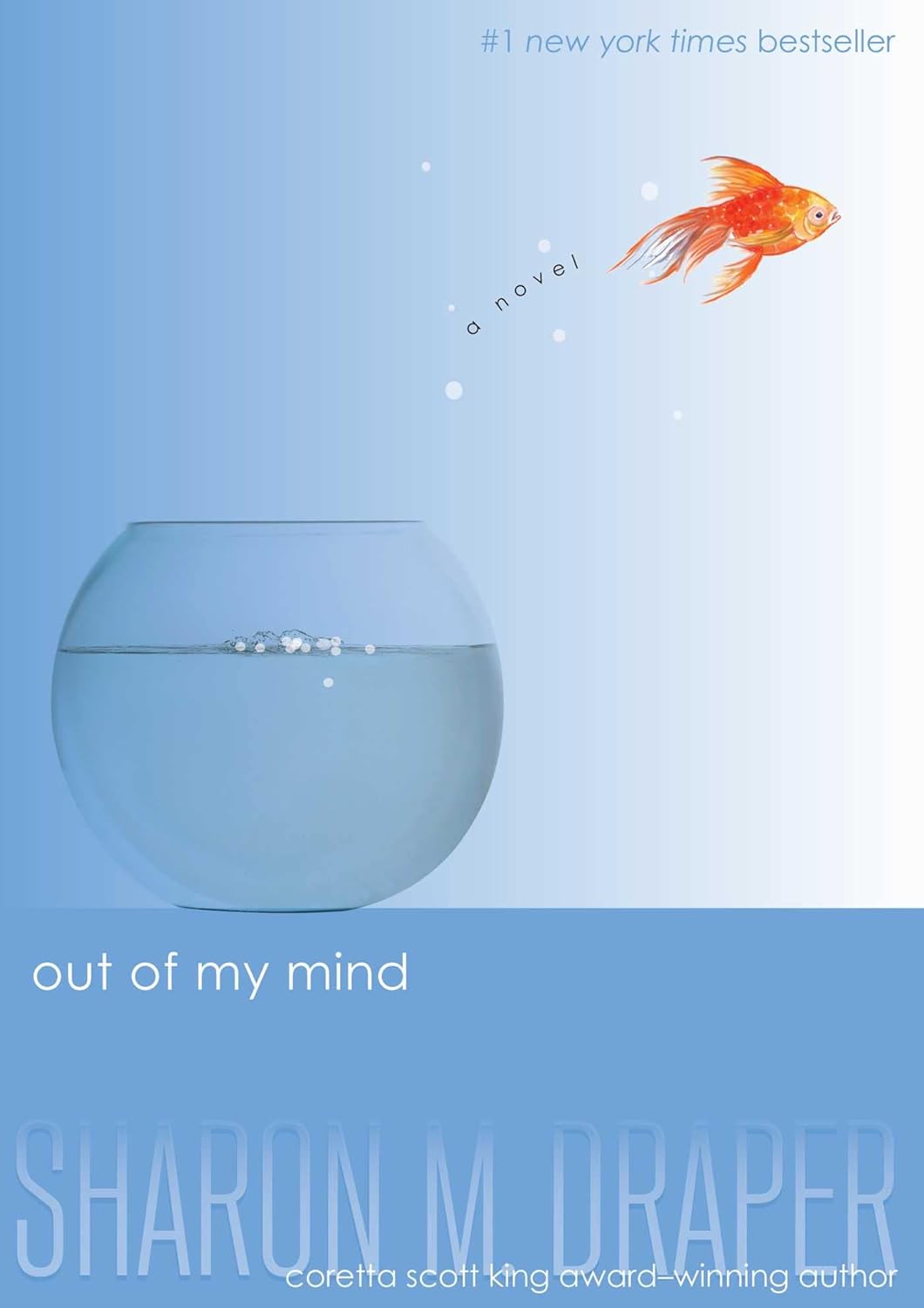
This complete guide to Out of My Mind by Sharon M. Draper covers everything parents, teachers, and students want to know — from reading level and recommended age to a full character breakdown, key themes, and the best books to read next. Published in 2010 by Atheneum Books for Young Readers, Out of My Mind is a New York Times bestseller that spent more than 18 months on the list, a multi-state award winner, and one of the most widely assigned middle grade novels about disability and inclusion in American classrooms. It is narrated by Melody Brooks, an eleven-year-old girl with cerebral palsy who cannot walk, talk, or write — but who has a photographic memory, a love of language that borders on obsession, and an intelligence that the people around her are almost entirely failing to see. This guide gives parents, teachers, and students the information they need before, during, and after reading.
For Parents
Out of My Mind is an emotionally powerful novel that asks readers to sit inside the experience of being profoundly misunderstood — to feel, from the inside, what it is like to be brilliant and have no way to show it. The content is emotionally intense in places but appropriate for ages 10 and up: a child is accidentally struck by a car (she recovers), a professional dismisses Melody as “brain-damaged” without adequately assessing her intelligence, and classmates are routinely cruel. There is no sexual content, no profanity, and no graphic violence. Common Sense Media rates it age 10+. The book is especially meaningful for families with a member who has a disability or communication difference — and for parents who want to build empathy in children who do not.
For Teachers
Out of My Mind appears on state reading lists across the country and has won literary awards from numerous states — making it one of the most broadly adopted classroom novels at the upper elementary and middle school level. Its portrait of what inclusion actually requires (not just physical proximity, but genuine acceptance) makes it a natural centerpiece for units on disability, empathy, and social justice. Lexile 700L, ATOS 4.3 — solidly mid-range text complexity for the target grades 4–6. Draper’s first-person, present-tense narration is an excellent model for teaching voice and point of view. A full reading group guide is included in most editions.
Out of My Mind at a Glance
Find on Amazon →| Author | Sharon M. Draper |
| Published | 2010 (Atheneum Books for Young Readers / Simon & Schuster) |
| Grade Level | 4–6 (our assessment) |
| Recommended Age | 10–14 |
| Flesch-Kincaid Grade | ~4.3 |
| Word Count | ~65,000 |
| Pages | 295 (hardcover); 320 (paperback) |
| Genre | Realistic fiction / Contemporary middle grade |
| Setting | Spaulding Street Elementary School and the surrounding community; contemporary Ohio |
| Awards | New York Times Bestseller (18+ months); Bank Street Josette Frank Award (2011); Kirkus Best Children’s Book of 2010; multiple state literary awards; featured on state reading lists nationwide |
| Film Adaptation | Disney+ original film (premiered Sundance 2024) |
For official Lexile and AR levels, visit Lexile.com or AR BookFinder. ReadingVine provides independent editorial assessments.
What Reading Level Is Out of My Mind?
Out of My Mind has a Lexile score of 700L and an ATOS (Accelerated Reader) level of 4.3. These metrics place it at approximately a fourth-grade text complexity — squarely in the middle of the range for books assigned at grades 4–6. Our editorial assessment is grades 4–6, with a recommended age of 10–14. The Booksource interest level is grades 4–8, and the novel’s emotional and thematic content makes it genuinely appropriate for that full span: upper elementary readers will respond to the school story and friendship elements, while middle schoolers will engage more deeply with the novel’s questions about ableism, institutional failure, and what it actually costs to be “included.”
One important nuance: the Lexile score reflects the accessibility of the prose, but not the emotional intensity of the reading experience. Draper writes in a first-person voice that is warm and direct, and the chapters are short enough to sustain momentum — but the novel asks readers to spend sustained time inside the experience of a child who is being systemically failed by most of the adults around her, and that is not an easy thing to sit with. For readers who have a family member with a disability, or who have experienced being misunderstood or dismissed themselves, the book can be deeply moving. For readers who have not, it can be unsettling in the best possible way.
For official Lexile and AR scores, visit Lexile.com or AR BookFinder.
What Age Is Out of My Mind Appropriate For?
We recommend Out of My Mind for readers ages 10–14. Common Sense Media rates it age 10+. The novel is largely free of the content that typically concerns parents — there is no sexual content, no significant profanity, and no graphic violence. What the book does contain is emotional intensity, and that is worth knowing about before your child reads it.
The most emotionally intense sequence occurs near the end of the novel: Melody’s toddler sister Penny runs behind the family’s car as their mother is backing out of the driveway. Melody, who does not have her communication device with her, cannot warn her mother in time. She tries desperately — screaming, flailing, pulling at her mother’s shirt and hair — and her mother, unable to understand what Melody is trying to communicate, slaps her on the leg. Penny is struck by the car and breaks her leg; she recovers and will be fine, but the scene is harrowing, particularly because it illustrates so precisely the cost of being unable to communicate. This scene is preceded in the plot by the quiz team betrayal (Melody’s teammates leave for nationals without calling her), which is its own kind of devastation. Some younger readers find the ending of the novel, while defiant and true to Melody’s character, frustrating rather than satisfying — it does not wrap cleanly. Other content includes a doctor who labels Melody as “profoundly retarded” without adequately assessing her intelligence — Melody’s cerebral palsy is correctly identified, but the adults around her consistently fail to recognize the mind inside it — along with ongoing condescension and bullying from classmates, and the general portrait of how disability is handled (and mishandled) by a school system. No sexual content. No significant profanity. No graphic violence.
For families: the novel is an excellent read-alongside book, particularly for parents who want to have conversations about disability, empathy, and what inclusion really means. For children who have a sibling or classmate with a communication difference, it can be profoundly affirming. Many school counselors recommend it specifically for that reason.
What Is Out of My Mind About?
Melody Brooks has been collecting words since before she could do anything with them. Cathedral. Mayonnaise. Iridescent. The novel opens with a love letter to language — to the experience of a mind that absorbs everything it encounters, that holds every word it has ever heard, every conversation, every song, every story. The catch is that Melody’s cerebral palsy means she has never spoken a single one of those words out loud. She cannot walk. She cannot write. She cannot feed herself. Her body does not do what her mind tells it to. And most of the people around her — her doctors, her teachers, many of her classmates — have looked at the body and decided there is nothing much happening inside it. They are wrong.
The novel follows Melody from infancy through fifth grade, tracing the slow, accumulating frustration of a child who is trapped behind a wall she didn’t build. Her parents love her and fight for her. Her neighbor Mrs. V — fierce, funny, relentless — has been drilling her on vocabulary cards and never once treated her as less than fully capable. When Melody enters fifth grade, an inclusion program finally places her in regular education classes, where she receives a classroom aide named Catherine, and eventually a Medi-Talker: a personal communication device that speaks for her, giving her access to tens of thousands of words for the first time. With that device, Melody is finally able to show the world what she has always known about herself. She aces the practice test for her school’s Whiz Kids academic competition. She makes the team. And then she learns, in the most painful possible way, that being seen is not the same as being accepted.
Sharon Draper wrote this novel drawing on her 25 years of teaching high school English and the students she encountered who used communication devices — as well as on her observations, during school visits, of the children who were too often overlooked in the spaces they occupied. The novel is simultaneously a portrait of individual resilience and a structural critique — of ableist assumptions, of the gap between legal inclusion and actual belonging, and of the specific cruelty of systems that are set up to fail the people they claim to serve.
Out of My Mind Characters
Is Out of My Mind Banned?
Out of My Mind has not been banned or formally challenged in any documented way. It does not appear on the American Library Association’s lists of challenged or banned books. It appears on state reading lists across the country and has won literary awards from numerous states, making it one of the most officially embraced classroom novels in the country. The novel’s clear and sympathetic portrayal of disability, and its argument for inclusion and empathy, give it a profile that tends to generate support rather than controversy. If your child’s school has assigned it, the book is well within the mainstream of middle grade classroom reading.
Out of My Mind Themes and Lessons
The novel’s central argument is about the difference between what people can see and what is actually there. Almost everyone who meets Melody sees the wheelchair, the drooling, the uncontrolled spasms — and concludes that the body tells them everything they need to know about the mind inside it. Draper gives us unfiltered access to that mind, which means every scene of dismissal or condescension hits twice: once as the external event, and once as Melody’s interior response, which is usually far more perceptive, more generous, and more precise than anything the dismissing adult could manage. The novel argues, persistently and without sentimentality, that the failure here is systemic and ongoing — not a matter of a few bad actors but of a whole structure built on assumptions that have never been seriously examined.
The secondary argument is about what inclusion actually requires. Melody’s school technically includes her — she is in the building, in the classes, on the team. But inclusion without belonging is its own kind of isolation, and the novel is honest about how different those two things are. The quiz team arc is the sharpest version of this argument: even when Melody proves herself by any measure the adults are willing to use, her teammates find a way to leave her behind. That is not a story about exceptional cruelty. It is a story about ordinary thoughtlessness at scale. For family and classroom discussion: What does it mean to truly include someone? What is the difference between tolerance and acceptance? When Rose fails Melody, is she a bad person or a normally fallible one? What does the Penny scene tell us about the cost of not being heard?
How Many Pages and Chapters in Out of My Mind?
The hardcover edition of Out of My Mind is 295 pages; the paperback edition is 320 pages. The novel has approximately 30 chapters, most of them short and quickly paced. Word count is approximately 65,000 words. At typical reading speeds for the target age group, most readers complete it in about one to two weeks of independent reading. The novel reads quickly partly because of the short chapters and partly because Melody’s voice is so immediate that it is difficult to put down once you are inside it. It works well as a classroom read-aloud; the first-person present-tense narration is particularly effective when read aloud, and Melody’s descriptions of her own inner experience are consistently striking enough to provoke discussion. A Disney+ film adaptation premiered at the 2024 Sundance Film Festival, with Phoebe-Rae Taylor cast in the lead role — watching the film after reading the book is a natural classroom extension activity.
Books Similar to Out of My Mind
About Sharon M. Draper
Sharon M. Draper was born in Cleveland, Ohio in 1948 and grew up reading voraciously — by age eleven she had worked through nearly every children’s book in her local library and been given a special card to check out adult titles. She earned her bachelor’s degree from Pepperdine University and her Master of Arts in English from Miami University of Ohio in 1973, then spent 25 years teaching high school English at Walnut Hills High School in Cincinnati, where she eventually became head of the English department. Her writing career began not with a plan but with a dare: a ninth-grade student challenged her to enter a writing contest, and she did, winning first prize — a $5,000 award and publication in Ebony magazine. Among those who wrote to congratulate her was Alex Haley, whose letter she credits with making her believe she could actually be a writer. She was named National Teacher of the Year in 1997, honored at the White House six times, and has met four U.S. presidents. She is a five-time winner of the Coretta Scott King Literary Award and the recipient of the Margaret A. Edwards Award for lifetime literary achievement from the American Library Association. Out of My Mind grew from Draper’s decades of teaching and her observations during school visits — she has said the children who always drew her attention were the ones in wheelchairs, the ones using communication devices, and that Melody had been “on her heart for a long time” before the novel finally came together. She drew on real individuals she encountered who used augmentative communication devices to give Melody’s experience its specificity and emotional truth. The book spent more than 18 months on the New York Times bestseller list and was adapted into a Disney+ film that premiered at the 2024 Sundance Film Festival. She lives in Florida. Her sequel, Out of My Heart, was published in 2021.
Out of My Mind: Frequently Asked Questions
What reading level is Out of My Mind?
Out of My Mind has a Lexile score of 700L and an ATOS level of 4.3. Our editorial assessment is grades 4–6, ages 10–14. The Booksource interest level is grades 4–8. The prose is accessible and fast-paced, but the emotional intensity of the reading experience — sitting inside a child’s mind while the world systematically fails her — warrants the upper end of that age range for most readers. For official Lexile and AR scores, visit Lexile.com or AR BookFinder.
What age is Out of My Mind appropriate for?
We recommend Out of My Mind for ages 10–14. Common Sense Media rates it age 10+. There is no sexual content, no significant profanity, and no graphic violence. The primary content for parents to know about is emotional: Melody experiences ongoing condescension and exclusion, a doctor severely underestimates her intelligence, her classmates repeatedly fail her, and the novel’s most harrowing sequence involves her toddler sister Penny being struck by a car (Penny recovers and will be fine). The ending is defiant but does not resolve cleanly. For children who have a disability, a sibling with a disability, or who have ever felt dismissed or overlooked, the book can be deeply affirming.
What happens to Penny in Out of My Mind?
Near the end of the novel, Melody’s toddler sister Penny runs out behind the family car as their mother is backing down the driveway. Melody, who doesn’t have her Medi-Talker with her, tries desperately to warn her mother — screaming, flailing, grabbing at her shirt and hair — but her mother cannot understand what she is trying to communicate and slaps her on the leg. Penny is struck by the car and breaks her leg. She has surgery and recovers fully; she will be fine. The scene is one of the most devastating in the novel precisely because it shows exactly what is lost when someone cannot communicate: Melody knew, she tried, and the system that should have made sure she always had her communication device had failed her.
Why does the quiz team leave Melody behind?
When a snowstorm cancels the Whiz Kids team’s scheduled flight to nationals in Washington D.C., the other students — who arrived at the airport early and had breakfast together without Melody — manage to book an earlier flight out before the storm hits. They do not call Melody’s family to let them know. The team goes to nationals without her and finishes ninth. When Melody confronts them at school, they offer excuses and present her with the plastic ninth-place trophy; she knocks it to the floor and uses her Medi-Talker to tell them she doesn’t want it. The scene is not about exceptional malice — none of Melody’s teammates are monsters. It is about how ordinary thoughtlessness, at scale, produces the same result as deliberate exclusion.
Is Out of My Mind based on a true story?
The novel is not based on a specific true story, but it draws from real experience. Draper spent 25 years as a high school English teacher and encountered students who used augmentative communication devices — their experiences and the ways schools succeeded and failed them informed Melody’s story. Draper has also said that during school visits she was always drawn to the children in wheelchairs and those who used communication devices, and that Melody had been “on her heart for a long time.” The novel is fiction, but its emotional authenticity comes from sustained observation of real children navigating real systems.
Is there a movie of Out of My Mind?
Yes. A Disney+ original film adaptation of Out of My Mind premiered at the 2024 Sundance Film Festival, with actress Phoebe-Rae Taylor cast as Melody. The film was released for streaming on Disney+. Sharon Draper attended the Sundance premiere and has been publicly supportive of the adaptation. Watching the film after reading the book is a popular classroom extension activity, particularly for discussion of what is gained and lost in adapting a first-person novel to the screen.
Does Out of My Mind have a sequel?
Yes. Out of My Heart (2021) is the sequel, following Melody the summer after fifth grade when she attends an overnight camp for children with disabilities. It explores themes of independence, identity, and what belonging looks like when you’re surrounded by people who understand your experience from the inside. It stands somewhat independently but is best read after Out of My Mind.
What awards has Out of My Mind won?
Out of My Mind spent more than 18 months on the New York Times bestseller list and received starred reviews from School Library Journal, Booklist, and Kirkus Reviews. It won the Bank Street College of Education Josette Frank Award in 2011 and was named a Kirkus Best Children’s Book of 2010. It has received literary awards from multiple states and appears on state reading lists across the country — making it one of the most widely institutionally recognized middle grade novels published in the past two decades. It did not win the Newbery Medal, a decision that has been noted (and occasionally debated) in children’s literature circles.