
 = Partner Site
Savvy Reading Level: A Complete Guide
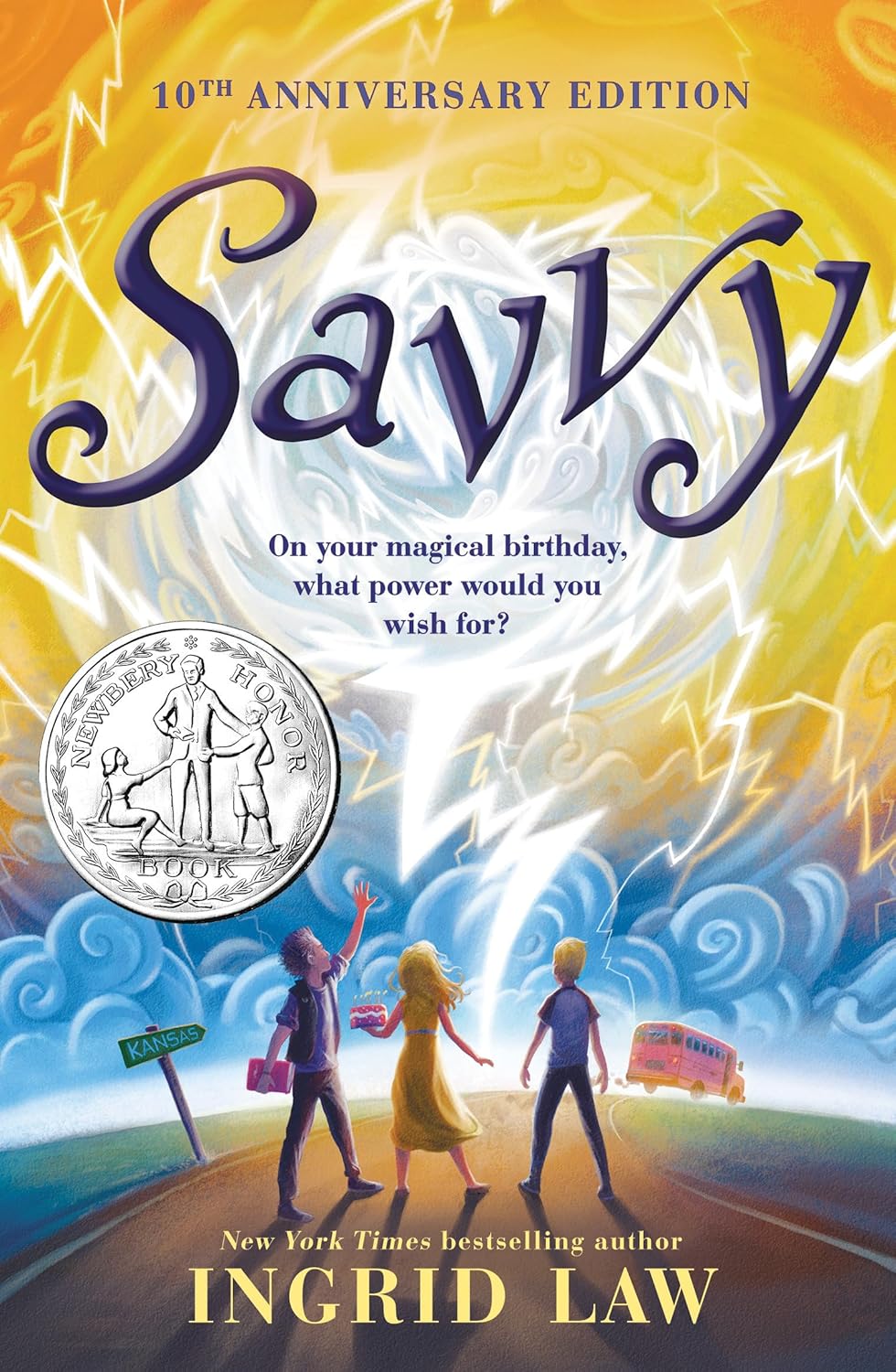
Savvy by Ingrid Law is one of the most inventive, most exuberantly written, and most genuinely enchanting novels in middle grade fiction — a magical realism story about a family in which every child, on their thirteenth birthday, develops a supernatural ability called a “savvy,” and about a girl named Mibs Beaumont who turns thirteen on the worst possible day and must figure out what her power is, what it’s for, and how to use it before it’s too late to help the person she loves most. Told in a voice so vivid and so distinctive that it reads like no other novel in the genre, it is a book about family, about growing up, about the specific terror and glory of discovering who you are, and about the way the things we’re given — the gifts and the burdens — are not always separable from each other. A Newbery Honor book that was also a New York Times children’s bestseller, it announced Ingrid Law as a writer of exceptional originality. This complete guide covers the reading level, age appropriateness, themes, characters, and everything parents and teachers need to know about this beloved novel.
For Parents
Savvy is a warm, funny, and genuinely moving novel for readers ages 8-12 that manages to be both a pure adventure — a road trip on a Bible-verse bus driven by a preacher’s son — and a rich coming-of-age story about a girl discovering what she is capable of. It contains nothing requiring parental guidance beyond the emotional weight of a parent’s injury and coma, which is handled with sensitivity and age-appropriate directness. It is one of the most reliably joyful reading experiences available at this level, and the kind of novel that children return to and reread with pleasure.
For Teachers
A Newbery Honor novel well suited to grades 4-6, Savvy is an exceptional text for teaching voice — Law’s first-person narration is one of the most distinctive and most technically accomplished in middle grade fiction, built on invented compound words, Southern rhythms, and a deeply specific sensory imagination. It also opens productive discussions about family, gifts and burdens, the relationship between power and responsibility, and growing up as a process of discovering rather than acquiring identity. The novel’s road trip structure makes it very accessible as a teaching text, with a clear arc and strong chapter breaks.
Savvy at a Glance
Find on Amazon →| Author | Ingrid Law |
| Published | 2008 |
| Grade Level | 4-6 (our assessment) |
| Recommended Age | 8-12 |
| Flesch-Kincaid Grade | 5.2 |
| Word Count | ~69,000 |
| Pages | 342 (standard paperback) |
| Chapters | 28 |
| Genre | Magical realism / adventure / coming-of-age |
| Setting | Nebraska and Kansas; a road trip on a Bible-verse bus, present day |
| Awards | Newbery Honor (2009); Publishers Weekly Best Book |
For official Lexile and AR levels, visit Lexile.com or AR BookFinder. ReadingVine provides independent editorial assessments.
What Reading Level Is Savvy?
Savvy reads at approximately a 4th-6th grade level by our editorial assessment, with a Flesch-Kincaid grade level of around 5.2. That score is reasonably accurate as a starting point but does not capture the novel’s most distinctive quality: Law’s voice. Mibs narrates in a first-person style built on compound invented words (“mumbledebumble,” “scrumbled”), run-on Southern rhythms that pile clause onto clause in the way of a girl thinking faster than she can organize her thoughts, and a sensory imagination so vivid and specific that the prose feels physically present in a way that standard readability measures cannot account for. The voice is the novel’s primary pleasure and its primary challenge simultaneously — readers who fall into it will find the 342 pages pass faster than almost any comparable novel; readers who resist it may find the opening chapters slow.
Beyond the voice, the novel’s demands are appropriate to its grade range. The plot is clear and propulsive, organized around the road trip that begins in chapter three and doesn’t stop until the end. The magical realism — the family’s savvies and their consequences — is never murky or confusing; Law presents the rules of the world with a matter-of-factness that makes the magic feel entirely plausible and the characters’ relationship to it entirely believable. Strong 4th grade readers will find it accessible; 6th graders will find it rich.
The book is most commonly recommended for grades 4-6. For official Lexile and Accelerated Reader scores, visit Lexile.com or AR BookFinder.
What Age Is Savvy Appropriate For?
We recommend Savvy for readers ages 8-12. It is one of the most content-appropriate novels in its range — a magical adventure story with genuine emotional stakes and nothing requiring parental guidance beyond the central dramatic situation.
The novel’s emotional engine is Mibs’s father’s hospitalization following a serious car accident that leaves him in a coma at the novel’s beginning. His condition is the reason for the road trip, the source of Mibs’s urgency, and the emotional weight beneath the adventure plot. It is handled with sensitivity and age-appropriate directness — the injury is not described in graphic detail, and the coma is presented as a serious and frightening situation without being traumatizing to read. The novel’s resolution addresses the father’s condition in a way that is satisfying and appropriate for the age range. There is no violence beyond the accident, no sexual content, and no strong language. The novel is entirely appropriate for readers at the lower end of the recommended age range. Its emotional demands are real — a parent in a coma is a frightening premise — but they are handled with the care of a novel that knows its audience and respects them.
Savvy is one of those novels that reads differently depending on the reader’s age — younger readers tend to respond most to the adventure and the magic; older readers in the range notice more of what the novel is saying about growing up, about the gifts we’re given that feel like burdens, and about family as the ground we stand on even when it’s shifting. It is equally rewarding at both ends of the recommended range, and it is one of the most reliably beloved read-alouds available at this level.
What Is Savvy About?
In the Beaumont family, every child develops a supernatural ability — a savvy — on their thirteenth birthday. Rocket can generate electricity. Fish can create storms. Grandpa Bomba can move land. The savvies are real, inherited, and entirely ungovernable at first — every new savvy requires what the family calls “scumbling,” the process of learning to control a power that arrives fully formed and completely unmanageable. The family lives off the grid, away from other people, partly because of the logistical challenges of having a father who generates lightning and a grandfather who occasionally raises mountains.
Mibs Beaumont is turning thirteen in two days. She has been waiting for her savvy her whole life — watching her brothers’ powers emerge, wondering what hers will be, terrified and excited in equal measure. And then, two days before her birthday, her father is in a serious car accident and is taken to a hospital in Salina, Kansas, unconscious and critical.
Mibs’s birthday arrives anyway. Her mother is at the hospital. Her older brother Rocket is holding the household together, and the family is waiting — for news about their father, for Mibs’s savvy to emerge. The birthday party Mibs doesn’t want is organized by well-meaning church ladies at the local pastor’s house, and it involves the pastor’s son Will Junior, his daughter Bobbi, and a pink bus painted with Bible verses that the pastor drives for his ministry.
Mibs has convinced herself that her savvy is the ability to wake people up — to bring her father back from his coma. It is not an unreasonable hope given what the rest of her family can do. Acting on that hope, she hides herself and her two younger brothers on the Bible-verse bus as it departs, intending to get to Salina and her father. Will Junior and Bobbi discover the stowaways and cannot turn back without alerting adults who will stop the whole expedition. The five of them are on the road together, heading toward Salina on a bus driven by a delivery driver named Lester who did not sign up for any of this.
The road trip is the novel’s great pleasure — five children and one bewildered adult on a pink Bible-verse bus, making their way across Nebraska and Kansas through a series of stops that are simultaneously comic and moving, each one deepening the characters and revealing more of Mibs’s emerging savvy, which turns out to be something considerably stranger and considerably more interesting than the ability to wake people up. What Mibs can actually do — hear the thoughts of the people whose skin she touches — is both a gift and a source of problems that the novel’s second half is largely organized around resolving.
The novel builds toward the hospital, toward Mibs’s father, toward a resolution that earns its emotional payoff through everything that has happened on the road. Law handles the ending with the same warmth and the same refusal to be sentimental that characterizes the best of the novel — not a rescue, but a recognition, which is the more lasting and the more honest kind of resolution.
Savvy Characters
Is Savvy Banned?
Savvy has not been challenged or banned and does not appear on any lists of challenged books. It is among the most broadly embraced novels in its grade range — its Newbery Honor reflects the institutional recognition of its literary quality, and its New York Times children’s bestseller status reflects its popular appeal. It is widely available in school and public libraries and is consistently recommended by educators, librarians, and parents as one of the most reliably joyful reading experiences available for the middle grade age range.
Savvy Themes and Lessons
The central theme of Savvy is the relationship between the gifts we are given and the burdens those gifts carry — the argument, made through the entire Beaumont family’s experience of their savvies, that the things that make us extraordinary are not separable from the things that make our lives difficult. Rocket’s electricity is magnificent and dangerous. Fish’s storms are awe-inspiring and catastrophic. Mibs’s ability to hear the thoughts of people she touches is intimate and overwhelming and sometimes devastating — she hears things she cannot unhear, things that complicate her relationship to everyone around her, things that require her to hold other people’s pain alongside her own. The novel’s argument is not that the gifts are worth the burdens despite everything, but that the gifts and the burdens are the same thing — that what makes each Beaumont child extraordinary is inseparable from what makes their life complicated, and that learning to live with both is what growing up in this family means.
Family as the ground we stand on — and the complexity of that ground — is the novel’s second great theme. The Beaumonts are a family defined by their differences from the ordinary world, by the management their savvies require, by the isolation those savvies have imposed. The novel’s warmth comes not from ignoring these complications but from the specific way the family holds them: with humor, with patience, with the particular love of people who know each other’s strangest parts and have chosen to keep choosing each other anyway. Mibs’s urgency to reach her father is the novel’s engine precisely because that love is so clearly and so thoroughly earned.
Empathy — the specific kind that comes from literally hearing other people’s inner lives — is the novel’s third great theme, and the one that connects Mibs’s savvy to the novel’s broadest argument. What Mibs can do is hear the thoughts that people carry beneath their surfaces: the sorrows they haven’t told anyone, the hopes they’ve given up on, the loves they’re still holding. This is not a comfortable power. It is, in the novel’s terms, a responsibility — and learning what to do with what you hear, how to use it carefully and with genuine care for the person it belongs to, is the scumbling Mibs must do. The argument the novel makes through her savvy — that understanding another person’s inner life fully and truly is both a gift and an obligation — is one of the most important available in middle grade fiction.
Discussion starters for classrooms: What is a savvy, and why does each Beaumont child’s savvy reflect who they are? What does it mean to scumble a savvy — is there a real-world equivalent? What does Mibs hear when she touches people, and what does she do with what she hears? How does the road trip change the characters who take it? What does the novel say about the relationship between what makes us different and what makes us valuable?
How Many Pages and Chapters Are in Savvy?
The standard paperback edition of Savvy is 342 pages, divided into 28 chapters averaging around twelve pages each. The word count is approximately 69,000 words — longer than many novels in this grade range, but the voice and the road trip structure keep the pacing brisk, and most readers find the pages pass faster than the count suggests. The chapters are well shaped for classroom use, with natural stopping points and strong hooks that make the novel difficult to put down at the assigned chapter.
For readers in the target age range of 8-12, expect a reading time of roughly 6-8 hours for engaged readers, or about two weeks at a comfortable reading pace. As a classroom text it works very well in a three-week unit, with particular richness available in discussions of voice, the magical realism rules, and the road trip as a narrative structure that creates natural opportunities for character development. The novel has two sequels: Scumble (2010), which follows Mibs’s cousin Ledger and his savvy — the ability to take things apart — and Switch (2015), which continues the Beaumont family’s story. Both sequels are well regarded, though Savvy stands fully on its own and is the most widely read of the three. Law has spoken about the Beaumont family as a world she built over years, and the depth and consistency of the magical system across the three novels reflects that sustained investment.
Books Similar to Savvy
About Ingrid Law
Ingrid Law grew up in a family that moved frequently — fourteen states before she finished high school — and has spoken about Savvy as rooted in that experience of being always slightly outside the ordinary, always in the process of finding out where you belong. The Beaumont family’s isolation and their fierce internal cohesion reflect something Law has described as autobiographical in spirit: the way families that are different from the norm develop their own specific culture, their own language, their own way of holding together against a world that doesn’t quite have a category for them. Savvy, published in 2008 when Law was in her forties, was her debut novel — a fact that surprises most readers, given the confidence and the specificity of Mibs’s voice. The novel was a New York Times children’s bestseller and a Newbery Honor book, launching a series that continued with Scumble (2010) and Switch (2015). Law lives in Colorado and has spoken extensively about the years of drafting and revision that produced Mibs’s distinctive voice — a voice that went through many versions before it became the one readers know, and that is, by any measure, one of the great achievements of contemporary middle grade fiction.
Savvy: Frequently Asked Questions
What reading level is Savvy?
Savvy has a Flesch-Kincaid grade level of approximately 5.2, which is reasonably accurate as a starting point but does not capture the novel’s most distinctive quality: Law’s voice. Mibs narrates in a style built on invented compound words, run-on Southern rhythms, and a vivid sensory imagination that makes the prose feel physically present in ways readability measures cannot account for. Readers who fall into the voice will find 342 pages pass very quickly. Most commonly recommended for grades 4-6 (ages 8-12). For official Lexile and AR scores, visit Lexile.com or AR BookFinder.
What is a savvy in the book?
A savvy is a supernatural ability that each Beaumont child develops on their thirteenth birthday — an inherited power that arrives fully formed, completely uncontrollable at first, and entirely specific to the individual child. Rocket’s savvy is electricity. Fish’s is storms. Grandpa Bomba’s is the ability to move land. What makes savvies distinctive in the novel’s magical system is that they cannot be chosen or trained for — they simply arrive, reflecting something essential about the person who receives them — and the work of learning to use them without causing harm is called scumbling, a process that can take years and that is the primary challenge of every Beaumont child’s adolescence.
What is Mibs’s savvy?
Mibs’s savvy is the ability to hear the thoughts and feelings of people whose skin she touches — specifically the thoughts and feelings they carry most deeply, the ones that have been written on them by experience and emotion. She hears these as voices, distinct and unmistakable, and what she hears cannot be unheard. She initially believes her savvy might be the ability to wake people up — she hopes she can bring her father back from his coma — and the discovery of what her savvy actually is, and what it means for how she moves through the world, is one of the novel’s central revelations. Her savvy is, in the terms of the novel’s argument, perfectly suited to a girl who has always paid close attention to the people around her.
What does “scumbling” mean in Savvy?
Scumbling is the Beaumont family’s word for the process of learning to control a savvy after it first emerges — the long, difficult, sometimes destructive work of bringing a fully formed and completely ungovernable power into something that can be used without causing harm. The word is borrowed from the visual arts, where scumbling refers to a technique of applying paint in a way that softens and blends rather than defines sharply — which is apt, since what scumbling a savvy requires is not the elimination of the power but its softening and focusing, learning to express it deliberately rather than have it express itself indiscriminately. Rocket’s scumbling took years. Fish’s is still in progress at the novel’s beginning. Mibs’s scumbling is the novel’s central learning arc.
Is Savvy part of a series?
Yes — Savvy is the first of three books in Law’s series. Scumble (2010) follows Mibs’s cousin Ledger Kale, whose savvy is the ability to take things apart — anything he touches disassembles itself, which creates predictable challenges — and shares the original novel’s road trip energy and warm family comedy. Switch (2015) returns to the Beaumont family for a third installment. Both sequels are well regarded and share the original’s distinctive voice and magical system. Savvy stands fully on its own and is the most widely read of the three; readers who love it consistently find the sequels equally rewarding.
Why is the bus covered in Bible verses in Savvy?
The bus belongs to the Reverend Meeks, the local pastor, who uses it as a ministry vehicle — driving it on deliveries and outreach while the Bible verses painted on its sides serve as a kind of mobile sermon. The bus and its verses are one of the novel’s most distinctive images, and the specific verses that appear at key moments in the road trip function as a running commentary on the story’s events — sometimes ironic, sometimes surprisingly apt. The bus also represents the accidental nature of the road trip itself: the children board it because it is there and leaving, not because it is the ideal transport for their mission, and the gap between the bus’s official purpose (ministry) and its actual function (getting five runaway children across Nebraska and Kansas) is one of the novel’s consistent comic pleasures.
What grade is Savvy typically assigned in?
Savvy is most commonly assigned in grades 4, 5, and 6, both as independent reading and as a classroom text. It is particularly well suited to units on voice in first-person narration — Law’s style is one of the most distinctive and most imitable in middle grade fiction, and student writing exercises modeled on Mibs’s voice (invented compound words, sensory specificity, run-on rhythms) are among the most productive available at this level. It pairs naturally with A Wrinkle in Time for a unit on families with extraordinary gifts, and with The Girl Who Drank the Moon for a unit on magical gifts that require learning rather than simply having.