
 = Partner Site
The House of the Scorpion Reading Level: A Complete Guide
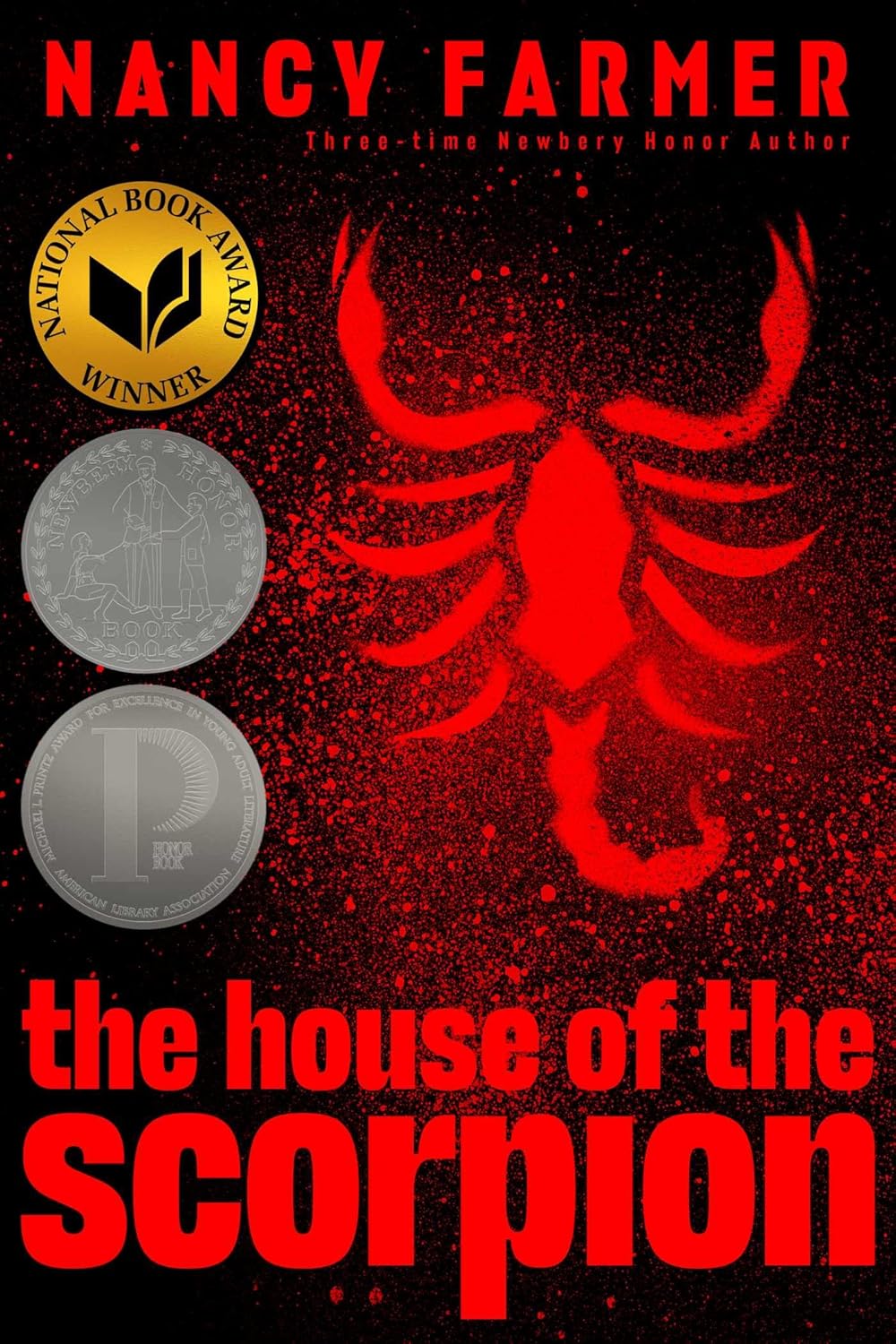
The House of the Scorpion by Nancy Farmer is a Newbery Honor-winning science fiction novel set in a future nation called Opium, carved out between the United States and Mexico, and ruled by a drug lord named El Patrón who has sustained his power — and his life — through a practice most people find monstrous: cloning. Matt is El Patrón’s clone, raised in secret and treated as less than human by nearly everyone around him, who must slowly piece together the truth of what he is and what he is meant for. Dark, propulsive, and morally serious, it is one of the most ambitious works of science fiction ever written for middle grade readers — a novel that takes its young audience seriously enough to ask genuinely difficult questions about identity, free will, and what makes a person human. This complete guide covers the reading level, age appropriateness, themes, characters, and everything parents and teachers need to know about this acclaimed and important novel.
For Parents
The House of the Scorpion is a sophisticated science fiction adventure with genuine literary ambition — a page-turning story that also happens to be a serious exploration of cloning, free will, identity, and authoritarian power. Best suited for readers ages 11-14, it is darker and more complex than most middle grade fiction, and the dystopian world it creates is genuinely threatening rather than sanitized. Parents of readers who are ready for something challenging, morally complex, and genuinely suspenseful will find this an outstanding choice.
For Teachers
A Newbery Honor and National Book Award winner well suited to grades 6-8, The House of the Scorpion is rich territory for teaching science fiction as a vehicle for ethical and philosophical inquiry. The novel’s questions — What makes a person human? Is identity determined by genetics or experience? What do we owe to people created for others’ use? — connect naturally to units on bioethics, dystopian literature, and the ethics of science. It pairs well with The Giver for a dystopian fiction unit, and with nonfiction on cloning and genetic ethics for a cross-curricular science and humanities unit.
The House of the Scorpion at a Glance
Find on Amazon →| Author | Nancy Farmer |
| Published | 2002 |
| Grade Level | 6-8 (our assessment) |
| Recommended Age | 11-14 |
| Flesch-Kincaid Grade | 5.6 |
| Word Count | ~130,000 |
| Pages | 380 (standard hardcover) |
| Chapters | 39 |
| Genre | Science fiction / dystopian fiction |
| Setting | Opium (between the United States and Mexico), the future |
| Awards | Newbery Honor (2003); National Book Award for Young People’s Literature (2002) |
For official Lexile and AR levels, visit Lexile.com or AR BookFinder. ReadingVine provides independent editorial assessments.
What Reading Level Is The House of the Scorpion?
The House of the Scorpion reads at approximately a 6th-8th grade level by our editorial assessment, with a Flesch-Kincaid grade level of around 5.6. That score understates the novel’s actual demands considerably. The prose is clear and Farmer’s storytelling is compelling — she is a gifted plotter who keeps the pages turning — but at 380 pages and roughly 130,000 words, this is a substantially longer book than most middle grade fiction, and its world-building, its cast of characters, and its ethical complexity all require sustained engagement.
The novel builds its dystopian world gradually, introducing the rules and horrors of Opium through Matt’s slowly expanding understanding rather than through exposition, which is the right approach artistically but demands patient, attentive reading. The moral and philosophical questions the novel raises — about cloning, identity, the ethics of creating life for instrumental purposes — are genuinely complex, and readers who engage with them seriously will get far more from the book than those who read it primarily as adventure fiction.
The book is most commonly assigned in grades 6-8 and recommended for ages 11-14. It is accessible to strong readers in 5th grade who are ready for more complex content. For official Lexile and Accelerated Reader scores, visit Lexile.com or AR BookFinder.
What Age Is The House of the Scorpion Appropriate For?
We recommend The House of the Scorpion for readers ages 11-14. The novel is one of the darker entries in the Newbery Honor catalog — its world is genuinely threatening, its villains are genuinely powerful, and some of its content is disturbing in ways that are intentional and meaningful rather than gratuitous.
The novel depicts a brutal authoritarian society in which human beings are enslaved through a surgical procedure that suppresses cognition (eejits), leaving them docile workers incapable of independent thought. This procedure is described with clinical specificity that is disturbing precisely because it is matter-of-fact. Characters are killed, including sympathetic ones. El Patrón is a genuinely menacing villain whose cruelty is depicted without softening. The novel’s central premise — that Matt was created to serve as an organ farm for El Patrón — is revealed gradually and carries real horror when it arrives. In the novel’s second half, Matt is sent to a labor camp run by children that is depicted with the logic of a totalitarian system. Drug trafficking and the political economy of the opium trade are central to the world-building. There is no sexual content and no strong language. The darkness is serious and purposeful, not gratuitous — but parents of sensitive younger readers should be aware of it.
The novel has been widely embraced by teachers and librarians as an outstanding and age-appropriate text for grades 6-8 despite its dark content, precisely because the darkness serves the story’s serious moral purposes. It is the kind of book that generates genuine discussion and that stays with readers long after they finish it.
What Is The House of the Scorpion About?
Somewhere between the United States and Mexico, in a future where the border has been replaced by a nation called Opium, a boy named Matt grows up in a small house with a woman named Celia, isolated from the world around him. He doesn’t know why he can’t go to school, why he can’t leave, why the other children who discover him recoil in horror and call him an animal. When he finally escapes the house and is taken to the vast mansion at the center of Opium, he begins to understand: he is a clone, created from the cells of El Patrón, the 148-year-old drug lord who rules Opium with absolute power. And clones, in this world, are not considered people.
El Patrón is the only person who treats Matt as human — who gives him an education, music lessons, books, and something that feels, confusingly, like love. Matt is the old man’s clone, his genetic twin, the living image of what El Patrón once was, and the old man’s attachment to the boy is real even as its purpose is horrifying. Because El Patrón is 148 years old, and he has stayed alive this long through a series of organ transplants, and clones exist to provide those organs. Matt has been grown as a spare parts depot — as El Patrón’s insurance against death. When the time comes, his heart will be harvested, and that will be the end of him.
The novel follows Matt through his discovery of this truth and his flight from Opium into the wider world — a world that is also broken, but differently, and that offers him the possibility, for the first time, of choosing who he will be rather than having it chosen for him. The question the novel pursues is the most fundamental question of identity: if you are genetically identical to someone, if you share their DNA and their face, are you the same person? Or does the life you live, the choices you make, the love you give and receive, make you something entirely your own?
Nancy Farmer drew on the real history of the US-Mexico border, the political economy of drug trafficking, and the scientific and ethical debates around cloning — which were particularly heated in the early 2000s when the novel was written — to build a world that is speculative but grounded in genuine contemporary concerns. The sequel, The Lord of Opium, was published in 2013.
The House of the Scorpion Characters
Is The House of the Scorpion Banned?
The House of the Scorpion has appeared on challenged book lists in some school districts, primarily due to its dark content — the depictions of mind-control slavery, violence, and the brutal logic of its authoritarian world — and occasionally due to its treatment of drug trafficking as a political and economic system. It does not appear prominently on ALA lists of most frequently challenged books. The educational community has broadly defended the novel as an outstanding and age-appropriate text for grades 6-8 whose darkness serves serious literary and ethical purposes. It is widely assigned and shelved in middle schools and libraries across the country.
The House of the Scorpion Themes and Lessons
The central question of The House of the Scorpion — what makes a person human? — is one of the oldest questions in philosophy, and Farmer approaches it through science fiction with genuine rigor. Matt is genetically identical to El Patrón, shares his face and his DNA, and yet is clearly, completely different. He has been shaped by different experiences, different loves, different moral pressures, and he has made different choices. The novel’s argument is that identity is not given by genetics but built by living: that what we choose to do with who we are is more defining than what we were made to be.
El Patrón functions as the novel’s dark mirror for this argument. He grew up in poverty with nothing, as Matt does. He had intelligence, passion, and drive. And he became a monster. The novel does not offer a comfortable explanation for why — it acknowledges that circumstances shaped him, that injustice formed him, that the world was genuinely cruel to him before he was cruel to the world. But it insists, through Matt’s choices, that this does not make monstrousness inevitable. The same origins, the same genetics, can produce something entirely different if the choices are different. This is the most important thing Farmer is saying, and it is an argument worth having with young readers.
The eejits — the enslaved workers whose minds have been surgically destroyed — are one of the novel’s most disturbing inventions, and one of its most morally serious. They are people who have been made into tools, stripped of agency and selfhood. Their existence asks readers to think about the many ways in which human beings have been and are treated as less than human, and what it costs individuals and societies to maintain those systems.
Discussion starters for classrooms: What makes Matt different from El Patrón, given that they have the same DNA? Is Matt responsible for things El Patrón did? What does the novel say about the relationship between suffering and becoming cruel? What is an eejit, and what does their existence represent? What choice does Tam Lin make at the end, and why? If you were Matt, could you forgive El Patrón?
How Many Pages and Chapters Are in The House of the Scorpion?
The standard hardcover edition of The House of the Scorpion is 380 pages, divided into 39 chapters averaging around ten pages each. At approximately 130,000 words, it is one of the longer Newbery Honor books and substantially longer than most middle grade fiction — closer in length to a young adult novel. The chapters are well-paced and Farmer’s plotting is propulsive, making the length feel earned rather than excessive.
For readers in the target age range of 11-14, expect a reading time of roughly 10-14 hours, or two to three weeks of steady reading at 30 minutes per session. As a classroom text, the novel works well in a four-week unit, with the world-building of the first third requiring particularly careful attention and discussion. The sequel, The Lord of Opium, follows Matt directly from where this novel ends, and strong readers who finish the first book in a unit often want to continue independently.
Books Similar to The House of the Scorpion
About Nancy Farmer
Nancy Farmer was born in Phoenix, Arizona, in 1941 and spent years working as a lab technician and Peace Corps volunteer in India and Africa before turning to writing. Her unusual background — scientific training, extensive experience in the developing world, deep familiarity with folklore and mythology across multiple cultures — shows in her fiction, which is consistently more ambitious, more strange, and more morally serious than most children’s and young adult literature. The House of the Scorpion won the National Book Award for Young People’s Literature and the Newbery Honor in 2003 respectively; it was her third major award, following Newbery Honors for The Ear, the Eye and the Arm (set in a future Zimbabwe) and A Girl Named Disaster (set in Zimbabwe and Mozambique). The sequel, The Lord of Opium, was published in 2013. Farmer has spoken about her interest in the US-Mexico border and the political economy of drug trafficking as the real-world foundation for Opium, and about her conviction that children’s literature should not protect young readers from the world’s genuine darkness but should equip them to think about it.
The House of the Scorpion: Frequently Asked Questions
What reading level is The House of the Scorpion?
The House of the Scorpion has a Flesch-Kincaid grade level of approximately 5.6, but this score significantly understates the novel’s actual demands. At 380 pages and roughly 130,000 words, with complex world-building and serious ethical themes, our editorial assessment places it firmly at grades 6-8 (ages 11-14). For official Lexile and AR scores, visit Lexile.com or AR BookFinder.
What is Opium and is it a real place?
Opium is a fictional future nation created by Farmer as the novel’s setting — a strip of territory between the United States and Mexico, ruled by the drug lord El Patrón, whose economy is built entirely on the production and trafficking of opium. It is not a real place, but it is built from real political and economic dynamics: the US-Mexico border, the politics of drug trafficking, and the exploitation of migrant workers are all genuine contemporary issues that Farmer projects into a speculative future. Opium’s existence as a buffer state serves both El Patrón’s economic interests and the interests of the United States and Mexico, which use it as a managed border — a detail that gives the world its particular, uncomfortable plausibility.
What is an eejit?
In the world of the novel, an eejit is a human being who has had a microchip implanted in their brain that destroys their capacity for independent thought and will, leaving them obedient and docile workers incapable of resistance or self-direction. The procedure is irreversible. Eejits can perform tasks they are directed to perform but have no inner life, no will of their own, no ability to refuse or to want. They are human beings who have been made into tools. The eejits are one of the novel’s most disturbing inventions and one of its most morally serious — they represent the endpoint of treating human beings as resources rather than persons, and their existence is one of the horrors that Matt must come to terms with as he learns what Opium really is.
Is Matt the same as El Patrón?
Genetically, yes — Matt is El Patrón’s clone, created from the old man’s DNA, and he shares El Patrón’s face and genetic identity. But the novel’s central argument is that this genetic sameness does not make Matt the same person. El Patrón and Matt have had entirely different experiences, formed entirely different relationships, made entirely different choices. The novel insists, through everything that happens to Matt, that identity is built by living rather than given by genetics — that what you choose to do with who you are matters more than what you were made from. This is the question the book asks its readers to sit with: if you share someone’s DNA, are you responsible for their choices? And can you make different ones?
What grade is The House of the Scorpion typically assigned in?
The House of the Scorpion is most commonly assigned in grades 6, 7, and 8, both as independent reading and as a class text. It is particularly well suited to units on dystopian fiction, science fiction as social commentary, bioethics, or the ethics of cloning and genetic technology. It pairs naturally with The Giver for a dystopian fiction unit and with nonfiction on cloning, genetic ethics, or the US-Mexico border for cross-curricular work.
Why did The House of the Scorpion win the National Book Award instead of the Newbery Medal?
The Newbery Medal in 2003 was awarded to Crispin: The Cross of Lead by Avi; The House of the Scorpion received a Newbery Honor. It won the National Book Award for Young People’s Literature in 2002, which is awarded by a separate organization (the National Book Foundation) using different criteria. Winning both recognitions in the same award season — the National Book Award outright, and a Newbery Honor — reflects the novel’s unusually strong reception across the children’s literature community. The two awards together confirmed it as one of the most significant children’s books of its year.
Is there a sequel to The House of the Scorpion?
Yes. The Lord of Opium was published in 2013, eleven years after the original novel. It picks up directly where The House of the Scorpion ends and follows Matt into adulthood and the full weight of what he has inherited. The gap between publications means the sequel was written for an audience that had grown up alongside the first novel, and it is correspondingly more complex and more demanding. The first novel stands entirely on its own with a satisfying, complete arc; the sequel is for readers who need to know what comes next.
How does the novel handle the ethics of cloning?
With unusual seriousness and without easy answers. The novel presents cloning not as science fiction spectacle but as a genuine ethical problem: if you can create a human being, what do you owe that being? The society of Opium resolves this question by declaring clones non-human — animals, property, tools — which makes the answer easy and the practice sustainable. The novel challenges this resolution at every turn by making Matt so obviously, completely human: curious, loving, angry, afraid, capable of growth and choice. The horror of the novel is not that clones exist but that a society can look at a person and decide, for its own convenience, that he is not one. Teachers who want to extend the novel’s ethical discussions can connect it to contemporary debates about genetic technology, stem cell research, and the moral status of human life at various stages.