
 = Partner Site
Thunder Cake Reading Level: A Complete Guide
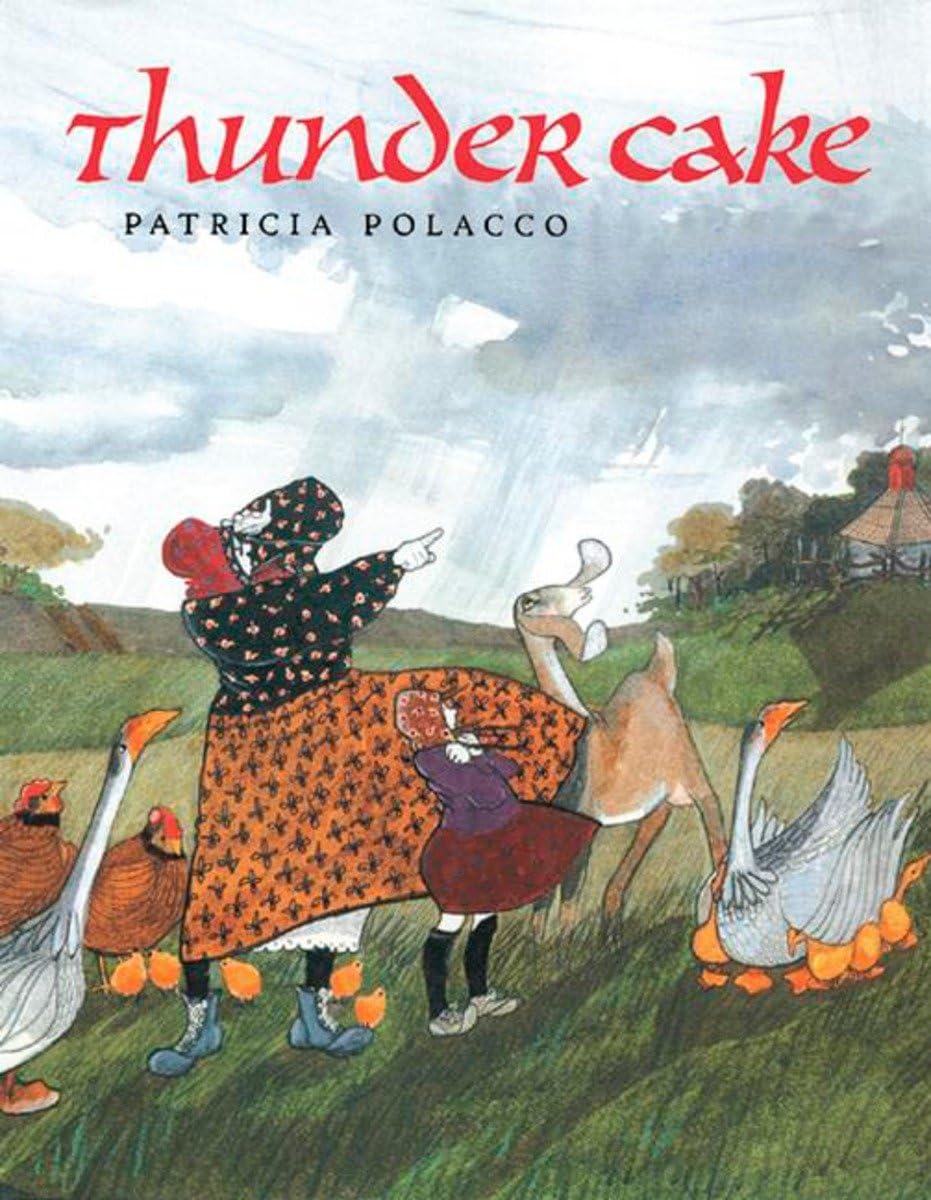
Thunder Cake by Patricia Polacco is a warm, folk-art-infused picture book drawn directly from the author’s own childhood — the true story of how her Russian grandmother, her Babushka, helped her overcome her fear of thunderstorms by turning the approaching storm into a race to gather ingredients and bake a cake before the thunder arrived. Published in 1990 and illustrated by Polacco herself in her distinctive bright, cross-hatched folk style, Thunder Cake is one of the most beloved books in the K–2 library for discussions of fear, courage, and the particular power of grandmothers who know exactly what to do. This guide covers the reading level, recommended age, read-aloud vs. independent reading guidance, themes, and everything parents and teachers need to know about sharing Thunder Cake with young readers.
For Parents
Find out whether Thunder Cake works best as a read-aloud or independent read for your child, what age range it suits, and why this story — drawn from Polacco’s own childhood on a Michigan farm, and ending with an actual recipe you can make together — is a highly useful book available for children who are afraid of storms.
For Teachers
Grade-level data, read-aloud timing, key themes, and discussion questions for a classroom staple in the K–3 range. Strong for discussions of fear and courage, for grandmother and family relationship themes, for the science of thunderstorms (counting between lightning and thunder), and as a natural tie-in to a cooking or measurement activity using the included recipe.
Thunder Cake at a Glance
Find on Amazon →| Author & Illustrator | Patricia Polacco |
| Published | 1990 |
| Grade Level | K–2 (our assessment) |
| Recommended Age | 4–8 |
| Best For | Read-aloud ages 4–8; independent reading ages 6–8 |
| Flesch-Kincaid Grade | 3.5 |
| Word Count | ~1,083 |
| Pages | 32 |
| Genre | Picture book / autobiographical / realistic fiction |
| Setting | A Michigan farm; during an approaching thunderstorm |
| Awards | California Young Reader Medal; Parents’ Choice Award; Booklist Starred Review |
For official Lexile and AR levels, visit Lexile.com or AR BookFinder. ReadingVine provides independent editorial assessments.
What Reading Level Is Thunder Cake?
Thunder Cake is a K–2 reading level by our editorial assessment, with a Flesch-Kincaid grade level of approximately 3.5 and a Lexile of 630L. At around 1,083 words it is one of the longer picture books on the K–2 list — comparable in length to Curious George or The Lorax — and the text includes some words that may require support for younger independent readers: Babushka, overcast, and the story’s specific sensory descriptions (“the air was hot, heavy and damp”) are richer than simple picture book vocabulary and reward a reader who takes them slowly.
What makes Thunder Cake accessible below its FK level is the clarity of its structure. The story moves forward in a single, urgent direction: gather the ingredients before the storm arrives. Each scene is a task completed, and each task brings the storm one count closer. Children who might struggle with the vocabulary are carried forward by the tension of the race — they want to know if the cake gets into the oven in time — which is a very effective reading-motivation structure. For parents who use specific reading level systems: we recommend checking your child’s level on Lexile.com or AR BookFinder for official scores, or asking your child’s teacher for their Guided Reading or DRA level.
Is Thunder Cake a Read-Aloud or Independent Read?
Thunder Cake works beautifully as both a read-aloud for ages 4–8 and an independent read for ages 6–8. As a read-aloud, it is a very satisfying picture book for this age range because the structure is so clean: a problem (the child is terrified of the storm), a plan (bake Thunder Cake before it arrives), and a series of missions, each with its own small courage required. The pacing accelerates naturally as the storm closes in, and the payoff — the cake comes out of the oven just as the storm reaches the farm, and the child eats Thunder Cake on the porch watching the lightning — is genuinely wonderful. Most adults can read Thunder Cake aloud in about 8–12 minutes.
As a read-aloud, Babushka is the key. She is calm in a way that is not dismissive — she does not tell the child her fear is silly, she takes it seriously enough to build an entire plan around it — and her voice is warm, confident, and full of the specific authority of a grandmother who has seen many storms. Reading her lines with that combination of warmth and matter-of-fact certainty delivers the book’s central emotional gift: the feeling that someone who loves you completely knows exactly what to do, and that if you follow their plan, you will be all right. Children who need that reassurance — children who are afraid of storms, of new situations, of big feelings — receive it very directly from this book.
For independent reading, a confident first or second grader can handle the text. The Lexile of 630L places it at the upper end of the grade 1–2 independent range, and it reads smoothly for children who are ready for slightly longer, richer picture book prose. The recipe at the end of the book is a natural extension activity that many families use as the occasion for making Thunder Cake together, which extends the book’s life well beyond the reading itself.
Before you start, count between a flash of lightning and the next thunder clap the way Babushka teaches — “one, one-thousand, two, one-thousand” — and tell your child that each number is roughly one mile. Then, as you read, count along with the story as the storm closes in: ten miles, nine miles, eight. Children who are actively measuring the storm’s approach alongside the characters feel the tension of the race more vividly, and the moment the cake goes into the oven is more satisfying when you know exactly how close the storm is. If you make Thunder Cake afterward, the recipe is in the back of the book.
What Is Thunder Cake About?
A thunderstorm is building over a Michigan farm. The narrator — Patricia, a small girl visiting her Russian grandmother — has hidden under the bed in terror. Her grandmother, her Babushka, does not tell her the storm is nothing to fear. Instead she says: “This is Thunder Cake baking weather.” If they are going to make Thunder Cake, they need ingredients — and they need to gather them before the storm arrives. The two of them set out across the farm: to the henhouse for eggs (where a mean hen makes getting them its own small bravery), to the garden for tomatoes, to the shed for milk from the cow (which is not happy about the thunder either). As they gather each ingredient, Babushka counts the distance of the storm from the seconds between the lightning and the thunder: ten miles, seven miles, five.
They make it back to the kitchen. The cake goes into the oven. The storm arrives in full. And when the cake comes out — a real Thunder Cake, with a real recipe that includes a secret ingredient (tomatoes) — they eat it on the porch together, watching the lightning. The fear has not vanished. But it has been transformed into something Patricia can do: count the seconds, gather the ingredients, make the cake. The book ends with Babushka’s quiet acknowledgment that anyone brave enough to gather those ingredients during a storm is too brave to be afraid of thunder. And she is right.
Thunder Cake Characters
Thunder Cake Themes and Lessons
The central theme of Thunder Cake is courage as something you do rather than something you feel. Babushka’s genius is that she does not ask her granddaughter to stop being afraid. She asks her to gather eggs from a mean hen, to fetch tomatoes from the garden, to get milk from a reluctant cow — and each of these tasks requires a small courage that has nothing to do with the thunder. By the time the cake is in the oven, Patricia has been brave enough for each ingredient, and Babushka’s accounting of this — “you were too brave to be scared of a little old thunder” — is not a trick or a distraction. It is true. The method is one of the most elegant demonstrations of cognitive-behavioral logic in children’s literature: you cannot eliminate fear directly, but you can redirect the energy it generates into action, and the action can be enough.
Thunder Cake is equally a portrait of the particular bond between a grandparent and a grandchild. Babushka does not parent Patricia — she grandmothers her, which is a different thing. She has the patience, the warmth, and the wisdom of someone who has already raised children and learned from it, and she brings to this one afternoon on the farm a quality of attention that is among the most valuable things a child can receive. Polacco drew this directly from her own experience — her Babushka was a real person, this farm was real, this afternoon was real — and the emotional authenticity of the relationship is legible on every page.
The book also carries the specific warmth of Russian folk heritage. Polacco’s background is partly Russian and Ukrainian, and the word Babushka, the folk-art visual style, and the specific sensibility of the grandmother — her warmth, her certainty, her recipes, her stories — all belong to a cultural tradition that Thunder Cake honors without requiring the reader to know anything about it. Children from Russian and Eastern European backgrounds recognize something specific in it; children from other backgrounds receive it as a window into a world of grandmotherly love that is particular and universal at the same time.
For teachers, Thunder Cake integrates naturally with simple weather science. Babushka’s method of measuring the storm’s distance — counting the seconds between lightning and thunder, with each second representing roughly one mile — is scientifically accurate and memorable. The book has been used in K–3 science units on weather as a narrative introduction to storm safety and lightning physics that children retain because they experienced it emotionally as well as intellectually.
Discussion starters for families: What was Patricia afraid of? What did Babushka do instead of just telling her not to be afraid? Which ingredient would have been hardest to get? Have you ever been afraid of a storm? What do you think you could do to feel brave during a storm? Should we try making Thunder Cake?
How Long Is Thunder Cake?
Thunder Cake has 32 pages and approximately 1,083 words. Most adults can read it aloud in about 8–12 minutes. The pacing accelerates naturally as the story builds — the early pages establish the farm and the fear, the middle pages move briskly through the ingredient-gathering missions, and the final pages slow down as the cake bakes and the storm arrives in full. Children who are engaged by the tension of the race against the storm find the book moves faster than its word count suggests.
A child reading independently at a first- or second-grade level will typically finish in about 10–15 minutes. The recipe at the end of the book adds a natural extension: many families who read Thunder Cake together make the cake immediately afterward, which turns the reading into a two-hour experience of the most enjoyable kind. The recipe includes a secret ingredient — tomatoes — that children find both surprising and delightful.
Books Similar to Thunder Cake
If your child loves Thunder Cake, these titles share its themes of courage, family bonds, or its place in the SEL and Character cluster:
About the Author and Illustrator
Patricia Polacco (born 1944) is an American author and illustrator who grew up in both Oakland, California, and in Michigan, where her family had a farm — the same farm where Thunder Cake is set. She comes from a family she describes as “marvelous storytellers,” with parents of Russian and Ukrainian descent on one side and Irish on the other, and her stories draw deeply on that heritage: the Babushka of Thunder Cake was her real grandmother, this afternoon during a real storm was a real memory, and the recipe at the back of the book is the actual Thunder Cake recipe her grandmother used.
Polacco did not publish her first book until she was forty-one years old. She has said that she struggled with severe dyslexia as a child and did not learn to read fluently until age fourteen — an experience she addressed directly in Thank You, Mr. Falker, another book on this list. She went on to earn an MFA and a PhD in art history, specializing in Russian and Greek painting and iconographic history, and her folk-art illustration style — bright, cross-hatched, richly textured, with slightly exaggerated features that give her characters enormous warmth and expressiveness — is immediately recognizable and entirely her own. She has published more than 70 picture books, most drawn from her family history, and lives in Michigan.
Polacco’s illustration method is central to what makes Thunder Cake feel the way it does. The farm is rendered in warm golds and greens that carry the heat of the pre-storm air; Babushka’s face holds the exact combination of warmth and authority the story requires; and the animals are drawn with the slightly out-of-scale quality Polacco has described as reflecting how a child actually perceives the world — animals bigger, adults warmer, everything more vivid than it will look when you are grown.
Thunder Cake: Frequently Asked Questions
What reading level is Thunder Cake?
Thunder Cake is a K–2 reading level by our editorial assessment, with a Flesch-Kincaid grade level of approximately 3.5 and a Lexile of 630L. At around 1,083 words it is one of the longer picture books on the K–2 list, with vocabulary that includes some richer words like Babushka and overcast. It works best as a read-aloud for ages 4–8 and as an independent read for ages 6–8. For official Lexile and AR levels, visit Lexile.com or AR BookFinder.
What age is Thunder Cake for?
Thunder Cake is appropriate for ages 4–8. As a read-aloud it works beautifully from age 4 — the storm-and-cake adventure is immediately engaging, and the fear Polacco describes is one children recognize viscerally. As an independent read it suits first and second graders ages 6–8. It is particularly well-suited to children who are afraid of storms, for whom the book offers not just reassurance but a specific, practical strategy: count the seconds, gather the ingredients, make the cake.
Is Thunder Cake a true story?
Yes — Thunder Cake is based directly on Patricia Polacco’s own childhood memory. The Babushka in the book was her real grandmother; the farm is the Michigan farm where Polacco spent her summers as a child; the thunderstorm, the recipe, and the afternoon of ingredient-gathering are all drawn from her actual experience. Polacco has described her grandmother’s approach to her storm phobia as one of the most formative memories of her childhood, and the recipe at the back of the book is the real Thunder Cake recipe her grandmother used.
How long does it take to read Thunder Cake aloud?
Most adults can read Thunder Cake aloud in about 8–12 minutes. The pacing accelerates naturally as the storm closes in, and the final pages settle into the warmth of the cake coming out and the storm arriving at full strength. Many families read Thunder Cake and immediately make the cake afterward using the recipe at the back of the book, which turns the afternoon into a two-hour experience of exactly the right kind.
What is the secret ingredient in Thunder Cake?
The secret ingredient in Thunder Cake is tomatoes — specifically, one cup of pureed tomatoes in what is otherwise a chocolate cake. The recipe at the back of the book is the actual Thunder Cake recipe Polacco’s grandmother used, and it works: the tomatoes add moisture and a subtle flavor depth that is not obviously “tomato” in the finished cake. The surprise of the secret ingredient is one of the book’s best plot moments, and many families and classrooms have made Thunder Cake after reading it.
What does “Babushka” mean in Thunder Cake?
Babushka is a Russian word meaning grandmother — an affectionate term for an older woman that carries associations of warmth, wisdom, folk knowledge, and the particular authority of age and love. Polacco uses it throughout Thunder Cake because her own grandmother was Russian, and the word is part of the cultural inheritance the book carries. Children from Russian and Eastern European backgrounds recognize something specific in it; children from other backgrounds often adopt the word enthusiastically, because it has exactly the right sounds for the character it describes.