
 = Partner Site
Turtles All the Way Down Reading Level: A Complete Guide
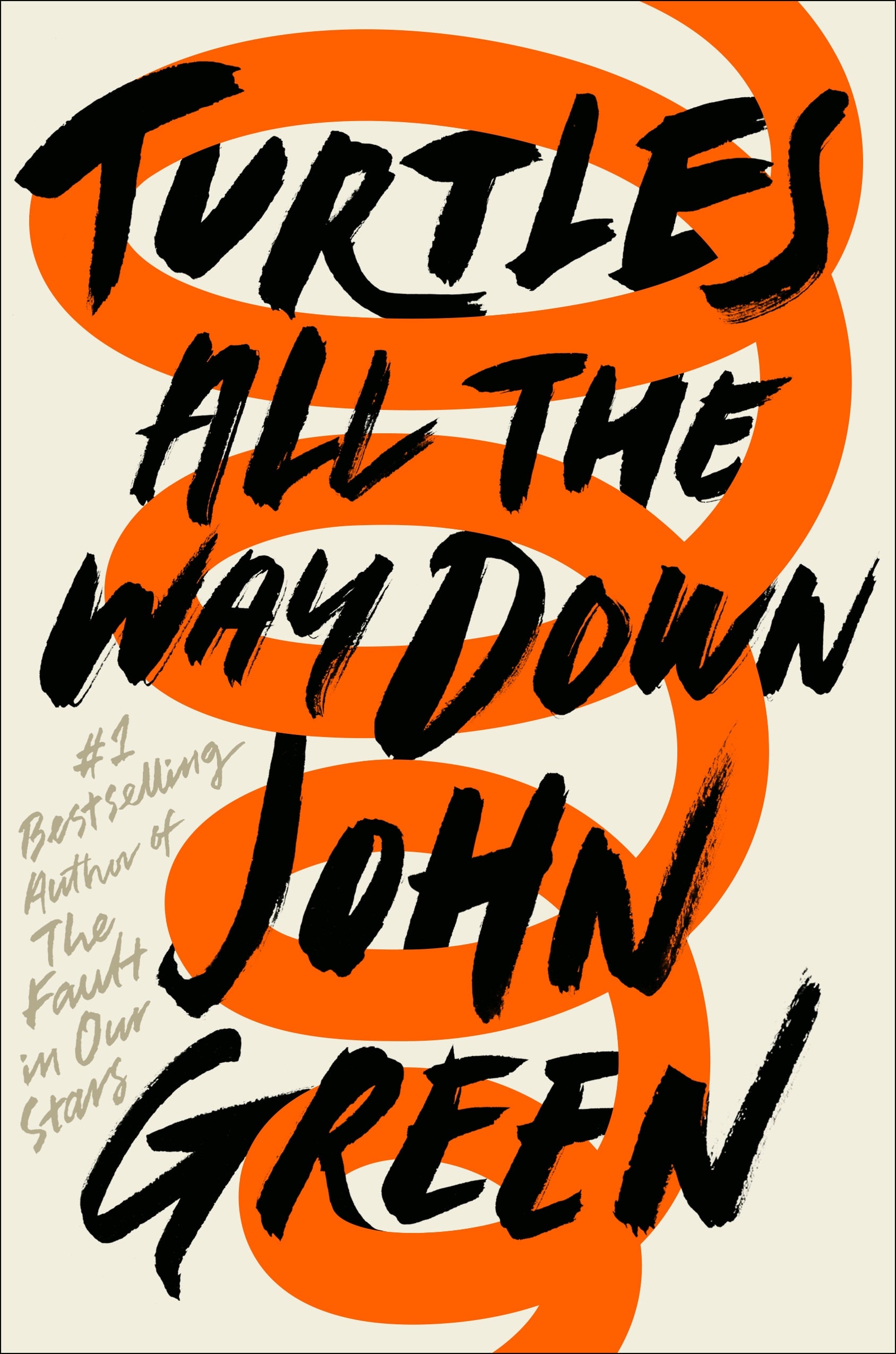
Turtles All the Way Down by John Green is a novel about Aza Holmes, a sixteen-year-old girl in Indianapolis who has OCD and anxiety and who is trying to be a good friend, a decent student, a not-terrible daughter, and a functional human being while her own thoughts circle inward in tightening spirals she cannot fully control. The plot involves a missing billionaire, a reward, and a boy named Davis, but the novel’s real subject is Aza’s experience of mental illness from inside — how it feels to live in a mind that will not stop, that returns relentlessly to the same intrusive thoughts, that cannot be persuaded or argued with or shut up. Published in 2017, it was Green’s first novel in six years and is the most autobiographical of his books: he has OCD and anxiety, and wrote the novel as a way of describing the interior of that experience as honestly as he could. This complete guide covers Turtles All the Way Down‘s reading level, recommended age, content considerations, characters, themes, and books similar to Turtles All the Way Down, designed for parents, teachers, and students.
For Parents
Green’s most personal novel and the one most commonly taught in schools — a coming-of-age story centered on OCD and anxiety told from deep inside the experience. Mild content compared to his other novels: some underage drinking, minimal sexual content, and mental health themes including intrusive thoughts and compulsive behaviors. Appropriate for ages 13 and up.
For Teachers
An excellent grades 9–11 text for teaching mental health literacy alongside literary analysis. The novel’s first-person narration of OCD is unusually specific and accurate — Green has OCD himself — making it valuable for discussions of unreliable narration, the relationship between interiority and plot, and how fiction can transmit the felt experience of mental illness more directly than clinical description. Green has described it as his least popular and most assigned novel, which he attributes to the relative absence of sexual content.
Turtles All the Way Down at a Glance
Find on Amazon →| Author | John Green |
| Published | 2017 (Dutton Books) |
| Grade Level | 9–11 (our assessment) |
| Recommended Age | 13+ |
| ATOS Reading Level | 5.6 |
| Lexile | 840L |
| Word Count | 62,868 |
| Pages | 320 (Dutton paperback) |
| Chapters | 24 |
| Genre | Young adult / coming-of-age / mental health fiction |
| Setting | Indianapolis, Indiana; present day |
For official Lexile and AR levels, visit Lexile.com or AR BookFinder. ReadingVine provides independent editorial assessments.
What Reading Level Is Turtles All the Way Down?
Turtles All the Way Down has an ATOS reading level of 5.6 and a Lexile of 840L — scores that accurately reflect the accessible YA prose. Green writes in the same contemporary first-person register as Looking for Alaska: clear, conversational, emotionally direct, with occasional flights into the philosophical that give his novels their particular flavor. The sentences are not difficult. The challenge, as with Looking for Alaska, is emotional and experiential rather than lexical.
What makes Turtles All the Way Down distinct is that the challenge is specifically about interiority. Aza’s OCD is rendered from the inside, and the novel’s most demanding sections are the ones in which Aza’s thoughts spiral — returning to the same fear (that she might be colonized by Clostridioides difficile), circling tighter, becoming less and less responsive to reason. Green does not describe these thought spirals from outside and explain them; he renders them in real time, from within Aza’s perspective, which means that readers who have not encountered OCD before will experience it as Aza does: disorienting, relentless, and resistant to the rational counter-arguments that seem like they should work. This is the novel’s greatest literary achievement and its primary reading challenge. At 62,868 words and 320 pages across 24 chapters, most readers complete it in two or three sittings; classrooms typically take two weeks. For official Lexile and AR scores, visit Lexile.com or AR BookFinder. ReadingVine’s assessments are independent editorial judgments.
What Age Is Turtles All the Way Down Appropriate For?
We recommend Turtles All the Way Down for readers ages 13 and up. This is Green’s most content-accessible novel: there is minimal sexual content (a kiss), some underage drinking at a party, and mild profanity. The primary content consideration is the mental health material itself — Aza’s OCD is depicted with enough specificity and intensity that readers who have anxiety or OCD may find it emotionally activating, and readers who have never encountered these conditions may need some framing to understand what they are reading. Neither of these is a reason to avoid the novel; both are reasons to approach it with intention rather than casualness.
Green has spoken and written extensively about his own OCD, and has said that part of his purpose in writing the novel was to give readers who have these experiences a way of seeing themselves on the page. The novel is unusually valuable for mental health literacy: it conveys the felt experience of OCD more directly than most clinical descriptions, and it does so without romanticizing or catastrophizing the condition.
What Is Turtles All the Way Down About?
Aza Holmes is a sixteen-year-old girl in Indianapolis whose best friend Daisy is her primary source of grounding in the external world. Aza has OCD: she is consumed by a spiral of intrusive thoughts about whether she might be colonized by C. diff bacteria, thoughts she cannot shut off and that lead her to compulsive behaviors — checking the callus on her finger, reopening a wound to drain potential infection — that temporarily relieve the anxiety before it returns. She is also in therapy and on medication that helps, without solving the problem, and she is trying to function as a normal teenager while conducting most of her psychological life inside a closed thought loop she cannot get out of.
Daisy, who writes Star Wars fan fiction and is more practically ambitious than Aza, notices a news story: Russell Pickett, a billionaire whose company has been accused of environmental fraud, has disappeared. There is a $100,000 reward for information leading to his whereabouts. Aza and Davis Pickett were friends at “sad camp” — a grief support group for kids who had lost parents — when they were young; Davis is Russell Pickett’s son; Daisy thinks this connection is worth pursuing. Aza reaches out to Davis. She and Davis begin a relationship that is real and tentative and complicated by the fact that Aza is also investigating his father’s disappearance, a complication she does not know how to resolve.
The missing billionaire plot turns out to be largely a MacGuffin: it gives the novel its structure and its forward motion, but what the novel is actually about is Aza and Davis each navigating their own forms of isolation — Aza from inside her thought spirals, Davis from inside the wealth and privacy that have separated him from ordinary life — and finding that genuine connection is possible even when neither person can offer the other what they most want. Aza cannot stop the thoughts. She cannot be consistently present. She hurts Davis in ways she is aware of and cannot prevent. And he loves her anyway, within the limits of what that love can actually do for either of them, which is less than either wants but more than nothing.
The novel ends with Aza as an adult, looking back — from a present in which she has survived her own mind and built a life she does not fully own but occupies — on what she went through at sixteen. The resolution is not recovery but endurance: she is still Aza, still prone to the spirals, still turtles all the way down. And she is still here.
Turtles All the Way Down Characters
Is Turtles All the Way Down Banned?
Turtles All the Way Down has not been the subject of significant formal challenge or banning. It does not appear on ALA most challenged books lists and is not among the Green titles that have generated sustained removal activity. Green has noted, with some dark humor, that it is his least commercially successful novel and his most frequently taught in schools, and has attributed this partly to the fact that it contains the fewest references to sex of any of his novels — making it the easiest to assign without parental challenges. The novel’s mental health content has occasionally prompted discussion about whether it is appropriate for younger readers, but this has not produced documented formal challenges at any significant scale.
Turtles All the Way Down Themes and Lessons
The novel’s title comes from a philosophical anecdote about infinite regress: the idea that the world rests on the back of a turtle, which stands on another turtle, which stands on another — turtles all the way down. For Aza, this image describes the experience of OCD: the thought spirals have no bottom, no ground on which to rest. Every reassurance generates a new doubt; every answer generates a new question. You cannot get to the bottom because there is no bottom. This is not a metaphor Aza uses once and discards — it is the formal argument of the novel, the condition in which she lives, the thing she is trying to find a way to survive.
The novel’s central philosophical question — what is a self, if your thoughts are not within your control? — is one that OCD makes unavoidable. Aza experiences her intrusive thoughts as both hers and not hers: they arise in her mind, they carry her voice, and yet they do not feel like choices she is making. The novel explores what it means to be a self when the thoughts that fill your consciousness are not fully under your control, and whether the distinction between “having thoughts” and “being” those thoughts is one that can be maintained. This is the question the title is answering: if you follow the question of selfhood all the way down, you do not find a stable ground. You find more turtles.
Green has spoken explicitly about writing the novel from his own experience of OCD, and the novel’s treatment of mental illness is distinguished from most YA mental health fiction by its refusal to resolve. Aza does not recover. She learns to live with her condition — to manage it, to survive it, to build a life in which it is a feature rather than the whole — but she is still, at the novel’s end, a person with OCD. The novel’s ending is not recovery; it is persistence. And Green’s argument is that persistence is enough — that surviving is not lesser than recovering, and that a life lived inside a difficult mind is still a full life.
Discussion questions for classrooms and families: How does Green render the experience of OCD in real time — what does the prose do that clinical description of OCD cannot? What does the title mean as both a philosophical concept and a description of Aza’s thought spirals? What does Daisy’s frustration with Aza argue about the cost of loving someone with mental illness — is she right? What is the novel saying about the relationship between love and what love can fix? How does the adult Aza looking back from the epilogue change how you understand the novel’s ending?
How Many Pages and Chapters in Turtles All the Way Down?
The Dutton paperback is 320 pages across 24 chapters. Word count is 62,868. Most readers finish in two or three sittings; classrooms typically complete it in two weeks. At 24 chapters across 320 pages, the chapters average about 13 pages each — longer than the brief dated sections of Looking for Alaska but manageable as individual class discussion units. The epilogue, in which an adult Aza looks back on her teenage years, is brief and important: it changes the register of everything that came before it from present experience to memory, and it gives the novel a retrospective frame that the main text does not have.
Books Similar to Turtles All the Way Down
About John Green
John Green was born in 1977 in Indianapolis — the city in which Turtles All the Way Down is set. He studied English and Religious Studies at Kenyon College and worked briefly as a student chaplain at a children’s hospital before becoming a full-time writer. He published Looking for Alaska in 2005, won the Printz Award in 2006, and published a series of increasingly successful novels — An Abundance of Katherines, Paper Towns, and The Fault in Our Stars — before taking a six-year break during which his own mental health was a significant factor in his inability to write.
Green has OCD and anxiety and has been open about this throughout his career. He has described the six years between The Fault in Our Stars (2012) and Turtles All the Way Down (2017) as years in which the pressure of following his most successful novel combined with a worsening of his own mental illness to make writing almost impossible. Turtles All the Way Down is in significant ways the novel he wrote about the experience of not being able to write it — and more broadly, about what it is like to live inside a mind that has its own agenda. He has said it is his most personal book and the one he is most proud of.
He lives in Indianapolis with his wife Sarah and their two children. He is also one half of the VlogBrothers YouTube channel with his brother Hank Green, and the host of the podcast The Anthropocene Reviewed, which was also published as a book in 2021.
Turtles All the Way Down: Frequently Asked Questions
What reading level is Turtles All the Way Down?
Turtles All the Way Down has an ATOS reading level of 5.6 and a Lexile of 840L. These scores accurately reflect the accessible YA prose. The challenge is emotional and experiential rather than linguistic: the novel renders OCD from the inside in real time, which requires attentive reading and some preparation for readers who have not encountered the condition before. Our editorial assessment places it at grades 9–11, ages 13 and up. For official Lexile and AR scores, visit Lexile.com or AR BookFinder.
What grade is Turtles All the Way Down appropriate for?
We recommend grades 9–11, ages 13 and up. It is the most content-accessible of Green’s novels: minimal sexual content, some underage drinking, mild profanity. The mental health content — specifically the OCD thought spirals — may be emotionally activating for readers who have anxiety or OCD, and benefits from some classroom framing before reading.
How many pages are in Turtles All the Way Down?
The Dutton paperback is 320 pages across 24 chapters. Word count is 62,868. Most readers finish in two or three sittings; classrooms typically complete it in two weeks.
What is Turtles All the Way Down about?
Aza Holmes is a sixteen-year-old with OCD who is trying to function normally while her thoughts spiral inward in loops she cannot control. The plot involves a missing billionaire, a reward, and a romance with Davis Pickett — the billionaire’s son. But the novel’s real subject is Aza’s experience of living inside her own mind, and the question of whether genuine connection is possible when one person cannot fully escape their thought spirals long enough to be present for the other.
What does the title Turtles All the Way Down mean?
The title references a philosophical joke about infinite regress: a scientist lectures on the solar system and is told by an audience member that the world rests on the back of a turtle. When the scientist asks what the turtle stands on, the answer is “another turtle” — and so on, turtles all the way down. For Aza, the image describes OCD: her intrusive thoughts have no bottom, no ground of certainty on which to rest. Every reassurance generates a new doubt; every answer generates a new question. The turtles represent the impossibility of finding stable ground beneath the spirals.
Is Turtles All the Way Down based on a true story?
Substantially autobiographical in its mental health content. John Green has OCD and anxiety, and Aza’s thought spirals are drawn directly from his own experience. He has described the novel as his attempt to describe the interior of mental illness as honestly as he could — not as a narrative device but as the actual felt experience of living inside a mind that will not stop. The plot is fictional; the psychology is personal.
Is there a Turtles All the Way Down movie?
Yes — a film adaptation directed by Hannah Marks was released on Max (HBO Max) in May 2023, starring Isabela Merced as Aza and Caitlyn Dever as Daisy. It received positive reviews and was praised for its portrayal of OCD. It is rated PG-13 and is appropriate for the same age range as the novel.
How is Turtles All the Way Down different from Looking for Alaska?
Where Looking for Alaska is organized around a death and structured as a countdown, Turtles All the Way Down is organized around Aza’s ongoing mental illness and has no equivalent structural pivot. Looking for Alaska is more plot-driven; Turtles All the Way Down is more interior and more focused on the texture of daily life with a mental health condition. Looking for Alaska has significantly more sexual content and a more extensive challenge history. Green has said Turtles All the Way Down is his most personal novel; his most commonly taught; and, commercially, his least successful.